


Guest posting isn't dead. But the version most marketers still run — bulk outreach, thin content, link-first thinking — is outdated and increasingly dangerous. Google's Helpful Content system, AI search engines like ChatGPT and Perplexity, and editors who've seen a thousand lazy pitches have collectively raised the bar. The guest posts that produce results in 2026 look nothing like what worked in 2020. They look like content an editor would have commissioned on their own. This guide breaks down what changed, why it changed, and what to do differently — backed by data from Google, Muck Rack, and the shifting mechanics of AI search.
TL;DR
Guest posting in 2026 is no longer a link-building tactic. It is an authority-building strategy. Google's Helpful Content system penalizes sites hosting thin guest content at the domain level — a single low-quality placement can drag down your entire site. AI search engines like ChatGPT, Gemini, and Perplexity cite bylined articles from credible publications and ignore link farms entirely. Press release citations in AI tools grew 5x between July and December 2025 (Muck Rack), and editorial guest content follows the same pattern. The spray-and-pray approach isn't just ineffective — it's a ranking liability. What works: fewer placements on relevant publications, written by people with real expertise, structured around stories and original data. Platforms like TS Vive Media's guest post marketplace are built for this shift — connecting brands with vetted editorial placements instead of link inventories.
The Obituary That Never Landed
Every year since roughly 2015, someone publishes a post declaring guest posting dead.
Every year, brands that grow through earned media keep doing it — because it keeps working.
Here's what is actually true: the version of guest posting most people picture — mass outreach emails, generic 800-word articles stuffed with anchor text, placements on sites that exist to sell links — that version is finished. Google killed it. Slowly at first, then all at once when the Helpful Content system rolled into core ranking in March 2024.
But the underlying mechanic — placing expert-led content on a relevant third-party publication to build authority, earn referral traffic, and signal trust to search engines — is more valuable now than it has been in years.
The difference lies in execution.
Three Forces That Reshaped Guest Posting in 2026
1. Google's Helpful Content System Changed the ROI Math
Before 2022, a link was a link was a link. Close enough, anyway. You could publish a mediocre guest post on a marginally relevant site, collect your dofollow link, and move on. The ROI math was simple: more links meant better rankings.
Google's Helpful Content Update — launched in August 2022 and fully integrated into core ranking by March 2024 — broke that math.
The system now evaluates content at the site level. If a publication hosts large amounts of low-quality, promotional, or thinly written guest content, the entire domain gets downgraded. Not just the bad pages. Everything. Some publishers reported 40–80% traffic drops after the September 2023 update rolled out.
That means a link from a site that accepts everything is no longer just less valuable — it can actively hurt you. On the other side, a link from a site with real editorial standards carries significantly more weight than it did four years ago.
The spread between a good placement and a bad one has never been wider.
According to Google's own published guidance, the system specifically downgrades content that:
Exists primarily to attract search engine visits rather than help humans
Uses automation to produce content across many topics without demonstrated expertise
Gives readers a reason to search again because the content didn't actually answer their question
Describes information available elsewhere without adding original value
Run your last five guest posts through that list. How many survive it?
The practical implication is clear: fewer placements on high-quality sites with genuinely editorial content now deliver the best results. ROI is no longer about volume. It's about velocity of trust.
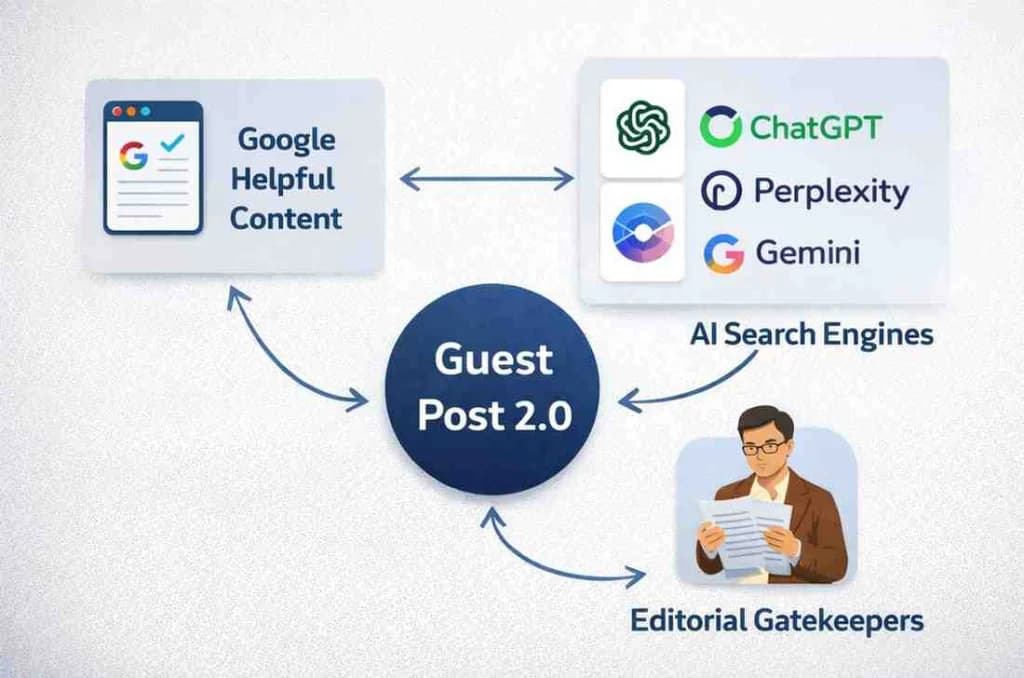
2. AI Search Engines Don't Care About Your Link — They Care About Your Source
ChatGPT, Gemini, and Perplexity are now part of how people discover brands. And the way these AI engines decide what to cite is fundamentally different from how Google's traditional algorithm works.
AI search tools pull from a narrower set of trusted editorial sources. They favour content with real bylines, original data, demonstrable expertise, and publication on authoritative domains. They don't follow links the way Googlebot does — they evaluate source credibility holistically.
The data backs this up. According to Muck Rack's Generative Pulse analysis of over one million AI citations, press release citations in AI tools grew fivefold between July and December 2025 — from 0.2% to 1% of all AI citations. When you include full distribution channels like Yahoo Finance syndication, the growth was from roughly 1.2% to 6% over the same window.
Editorial content — including quality guest posts — follows the same citation pattern. The publications where your bylined article appears are becoming part of the citation graph that AI uses to build answers.
The same Muck Rack research found that cited content contains 2x more statistics than non-cited content, 2.5x as many bullet points, 30% more objective sentences, and shows a strong recency bias — over 50% of AI citations reference content from the prior 11 months.
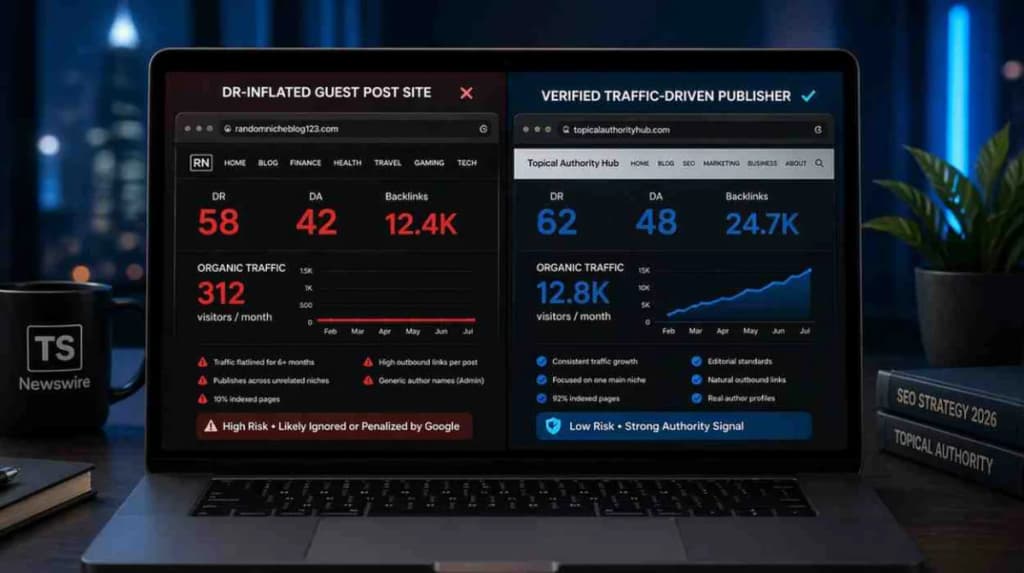
A guest post on a credible industry publication with real data and a real byline? That is exactly the kind of source AI engines cite. A guest post on a link farm with a DA of 55 but no real readership? Invisible.
If your guest posting strategy doesn't account for AI discoverability, you are optimising for a search landscape that is shrinking.
3. Audiences Got Smarter and Editors Got Pickier
Content consumption increased 207% globally during the COVID-19 lockdown period. That number gets cited a lot. What gets talked about less is what that did to audiences.
When every brand on earth publishes blog posts, LinkedIn articles, and "resources to support you during uncertain times" for 18 months straight — readers get very good, very fast, at detecting when they are being sold to rather than helped.
58% of consumers now say they trust educational content more than promotional content from brands. That number climbed every year since 2020. The audience became skeptical before the algorithm caught up.
Zero-click searches now account for 58% of all Google queries. More than half of all searches get answered in the SERP itself — no click ever happens. The only content that earns clicks in this environment promises something the snippet cannot deliver: a perspective, a story, or data that requires the full article to understand.
Meanwhile, Reddit is now the #3 most visible site in Google's US organic rankings, trailing only Wikipedia and Amazon. Reddit's domain authority sits at 99. What made Reddit rise? Authentic, experience-driven, story-based content written by real people. Nobody on Reddit upvotes a post that reads like a brand announcement.
Editors at publications worth pitching have raised their standards accordingly. They are publishing less, curating more, and rejecting anything that reads like it was written to tick an SEO box rather than serve their audience.
Does Guest Posting Still Work for SEO in 2026?
Yes. But only when the content is genuinely editorial.
Here is the framework:
Guest Posting in 2026 = Authority + Editorial Value + Strategic Distribution
That formula replaces the old one, which was: Volume + DA + Anchor Text = Rankings.
The old formula still circulates in plenty of SEO communities. It no longer works. Google's link spam policies are explicit about identifying patterns that resemble link schemes rather than genuine editorial coverage. And the E-E-A-T framework — Experience, Expertise, Authoritativeness, Trustworthiness — now directly shapes the types of content the algorithm rewards.
Content that demonstrates real Experience (the author has done the thing they're writing about) and real Expertise (they know the subject beyond surface-level talking points) earns preferential treatment across both traditional and AI search. A bylined guest post from a practitioner on a relevant publication is one of the strongest E-E-A-T signals you can build.
How to Write Guest Posts That Rank in 2026
"Write better content" is advice that helps nobody. Here is what specifically separates a guest post that moves the needle from one that doesn't.
It leads with a story or a point of view, not a product. The opening paragraph needs to hook the editor and the reader. If the first sentence mentions a company, a product, or a solution — it is not a guest post. It is an advertorial. Editors know the difference within seconds.
It demonstrates first-hand experience. A SaaS founder writing about lessons from scaling to 10K users is first-hand experience. A marketing agency writing a generic overview of "SaaS growth strategies" is not. Google's quality raters evaluate this distinction directly.
It includes original data, analysis, or insight. Something the reader cannot get from the other posts ranking for the same keyword. This is what makes AI engines cite your content over someone else's — specificity and originality.
The author bio is real. A real name, a real title, a real LinkedIn profile. Not "Guest Contributor" with a link to a homepage. The byline is an E-E-A-T signal, and AI engines use it when evaluating whether to cite the piece.
The link strategy is subtle. One contextually relevant link in the body or author bio. Not three links in the first 300 words with exact-match anchor text. Google's link spam policies are explicit on this — and editors will reject it before Google even needs to act.
The Old Process vs. The New Process
The process most teams still run: compile a list of sites that accept guest posts, send a template pitch to all of them, write a generic article when someone says yes, insert links, publish, repeat.
The process that works now is nearly the opposite: identify 5–10 publications whose audience genuinely overlaps with yours, study what they've published recently, develop a pitch that fills a gap in their existing coverage, write the piece to the publication's editorial standard — not your brand's marketing standard — and treat the placement as a relationship, not a transaction.
The first process scales easily and produces mediocre results. The second is harder to scale but produces placements that build authority, earn AI citations, and drive traffic that converts.
This operational friction — the cold emails, the spreadsheets, the months of back-and-forth — is one of the reasons we built the guest post marketplace on TS Vive Media. It connects brands directly with vetted publications across 40+ verticals, with transparent pricing, editorial standards, and real domain metrics. The goal is to remove the outreach friction without removing the editorial quality bar.
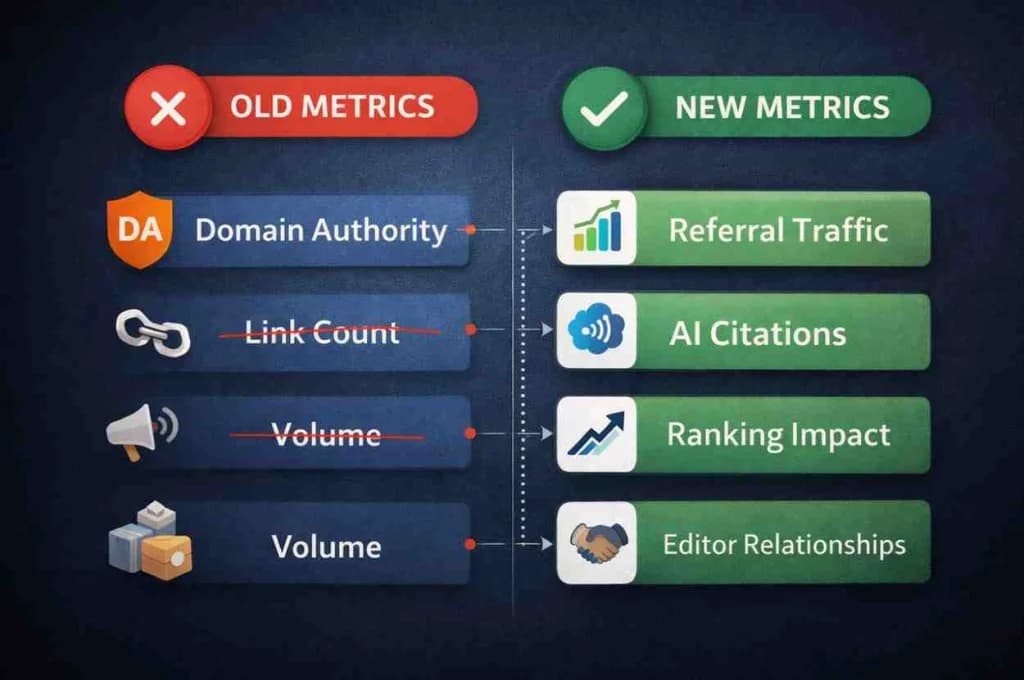
AI SEO and Guest Posting: The Metrics That Matter Now
If you are still measuring guest posting success primarily by number of links acquired and average DA of placement sites, you are measuring the wrong things.
Referral traffic from the placement. If nobody clicks through from the guest post to your site, the placement didn't reach a real audience. This is the simplest test of whether you placed on a site people actually read.
AI citation inclusion. Search for your brand in ChatGPT, Gemini, and Perplexity. Are your guest placements being cited in the answers these tools generate? If they are, you have placed on the right publications.
Ranking impact on target pages. Track the organic rankings of the specific pages your guest posts link to. A single editorial placement on a genuinely authoritative site can move rankings more than 20 placements on mediocre ones.
Brand mention growth. Guest posting done right increases the frequency with which your brand appears in editorial conversations — not just as a link, but as a referenced source.
Editor relationships. If an editor invites you back for a second piece, your first placement delivered value to their audience. Those repeat relationships produce compounding returns.
Why Most AI-Generated Guest Posts Fail
90% of large marketing teams now use AI for content creation. That means the volume of guest post pitches hitting editor inboxes has increased dramatically — and the average quality has dropped off a cliff.
Editors identify AI-generated guest posts within seconds. The tells are consistent: overly smooth transitions, absence of specific examples, generic frameworks that apply to any industry, and a complete lack of voice. Phrases like "in today's rapidly evolving landscape" are an instant signal. A specific observation about something that actually happened is not.
Google's spam policies explicitly address this. Scaled content abuse — using AI to produce large volumes of content without meaningful human oversight — is a violation that can trigger manual actions against a domain.
The smart approach: use AI for research, outlining, and first drafts. Then rewrite with real expertise, real data, and a real voice. The final piece should read like a human expert wrote it — because one did, with AI handling the research legwork.
A Quick Checklist Before You Hit Publish
Before submitting your next guest post, run it through these questions:
Would this piece get published even if there were no link in it? If you stripped out every reference to your brand, is the content still valuable to the publication's audience? Does the opening paragraph make the editor want to keep reading — not because it mentions a product, but because it tells a story or makes a claim worth examining? Does the author have genuine, demonstrable experience with the topic? Is the publication one your target audience actually reads — not just one with a high DA? Have you checked whether the site has been hit by Google's Helpful Content downgrades?
If you can answer yes to all of those, you have a guest post that will work in 2026. If you can't, you have a link-building exercise that probably won't.
Where This Goes Next
Guest posting is not going away. The format — expert-written content on a relevant third-party publication — is one of the most durable distribution strategies in digital marketing. What is going away is the shortcut version.
The brands that treat guest posting as editorial will earn compounding returns: better rankings, AI citations, referral traffic, and brand authority that accumulates over time. The brands that treat it as a link acquisition channel will watch their placements disappear from the SERPs as Google and AI search engines continue to tighten the filter.
The choice is simple. The execution is where most teams need help — which is exactly what a curated, quality-first marketplace approach is designed to solve.
Frequently asked questions
- Does guest posting still work for SEO in 2026?
- Yes, but only when the content is genuinely editorial. Google's Helpful Content system now evaluates sites at the domain level, meaning placements on low-quality sites can hurt rather than help rankings. Guest posts on relevant, editorially curated publications with real expertise and original insight continue to drive strong SEO results — including backlinks, referral traffic, and AI search citations.
- How has AI changed guest posting strategy?
- AI search engines like ChatGPT, Gemini, and Perplexity cite editorial content from credible publications when building answers. According to Muck Rack data, press release citations in AI tools grew fivefold between July and December 2025. Guest posts on authoritative sites with real bylines and original data are increasingly appearing in AI-generated responses — making guest posting an AI discoverability strategy, not just a link-building tactic.
- What makes a guest post effective in 2026?
- An effective guest post leads with a story or original point of view, demonstrates the author's first-hand experience, includes original data or analysis, carries a credible author byline, and uses a subtle link strategy with one contextually relevant link. The content should be strong enough to stand on its own without any brand mention.
- Is AI-generated content acceptable for guest posts?
- Publishing purely AI-generated guest posts is risky. Google's spam policies explicitly target scaled content abuse, and editors identify AI-written content quickly. The effective approach is using AI for research and drafting, then rewriting with genuine expertise, specific examples, and an authentic voice.
- How do I find quality sites for guest posting?
- Focus on publications whose audience overlaps with yours, study their recent editorial coverage, and pitch content that fills a gap. Avoid sites that accept everything or exist primarily to sell links. Curated marketplaces like TS Vive Media (tsvivemedia.com/register) connect brands with vetted publications across 40+ verticals, removing outreach friction while maintaining editorial quality.
- What metrics should I track for guest posting in 2026?
- Move beyond DA and link counts. Track referral traffic from placements, AI citation inclusion (search your brand in ChatGPT and Perplexity), organic ranking impact on linked target pages, brand mention growth across editorial conversations, and editor relationship quality — including whether you are invited back for follow-up pieces.
Distribute your next announcement with named outlets
One-time pricing, compliance review for regulated industries, and a publication report with live links you can verify.