

Quick answer
Affordable press release distribution in 2026 runs $25–$199 per placement — but price is the wrong first question. The real issue: when you blast one release across 400 wire sites, Google filters the duplicates and shows only 4–5 copies (usually Yahoo Finance, Morningstar, Barchart), and the "400 backlinks" get discounted as link spam — both confirmed by Google's own documentation. Mass wire blasts only make sense for compliance news, funding, or big-brand announcements. For startups, crypto, AI, and SaaS, buying individual publications beats a blast. In India, use ANI/PTI/HT Syndication for wires, but editorial brand stories for the big papers (Times of India, Hindustan Times). TS Newswire does both from one transparent dashboard — no retainers.
Every pricing guide for press release distribution tells you the same thing: budget wires cost $49–$150, PR Newswire charges $350+, Business Wire starts at $475, pick your tier. What none of them tell you is what happens after you pay — how many of those "400+ outlets" actually show up in Google, and whether a $49 blast ever reaches a journalist at all.
We've distributed more than 30,000 placements through TS Newswire since 2020 — across AP News, MarketWatch, StreetInsider, Benzinga, Reuters syndication, USA Today, and Indian publications like Times of India and Hindustan Times. That volume gives us data most pricing guides don't have. This guide shares it.
Bottom line: Affordable press release distribution in 2026 means $25–$199 per placement when you buy individual publications, or $49–$199 for a budget wire blast. But price is the wrong first question. The right first question is whether your announcement needs wide syndication (compliance news, funding, shareholder updates) or targeted visibility (product launches, brand building, SEO). Most small companies need the second — and buying it as a multi-wire blast wastes most of the money.

What "Affordable" Actually Buys You in 2026
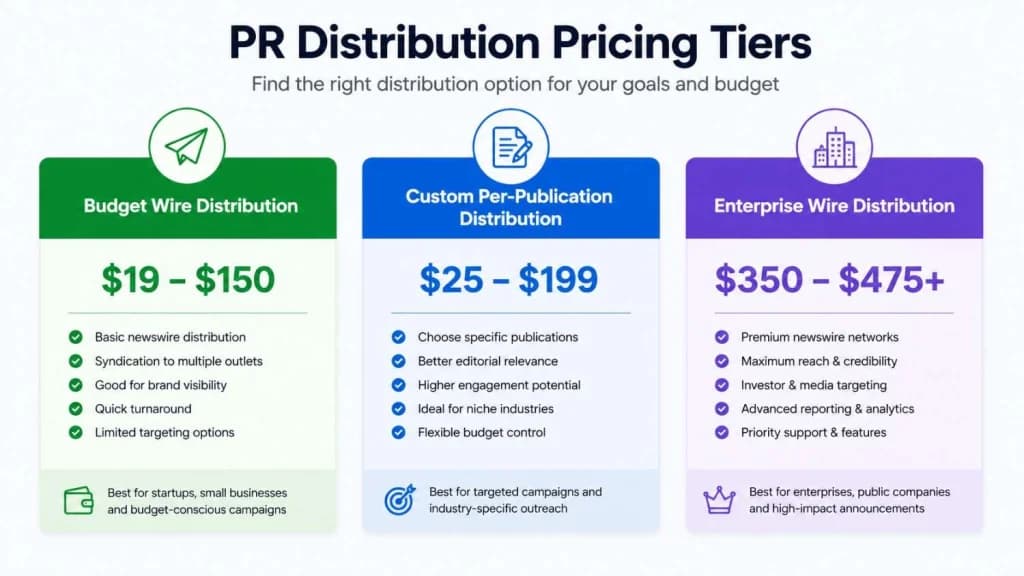
The press release pricing market splits into three tiers:
Budget wires ($19–$150 per release). Services like 24-7 Press Release ($49), PRLog ($49 premium), and EIN Presswire ($99.95+) syndicate your release across their partner networks. Reviews of the category consistently note the trade-off: EIN Presswire, for example, offers strong indexing and SEO reach but weaker placement on high-profile editorial sites — you get volume, not prestige.
Enterprise wires ($350–$475+ per release). PR Newswire runs $350+ per release plus an annual membership; Business Wire starts around $475. These networks exist for a reason — regulatory disclosure, investor relations, and broadcast-desk reach — but that reason usually isn't yours if you're a startup announcing a product.
Per-publication placement ($25–$199+ per site). The newest model, and the one most guides skip: instead of paying one fee for a syndication blast, you pay per named publication. On our own dashboard, StreetInsider placement starts at $25, Barchart at $29, Business Insider at $150, Yahoo Finance at $169, and a GlobeNewswire wire run from $199. You pick the outlets; you skip the ones that don't matter to you.
Which tier is right depends on one thing the pricing tables never mention: how Google treats syndicated copies of the same article.
The Multi-Wire Problem: Why Google Only Shows 4–5 Copies of Your Release
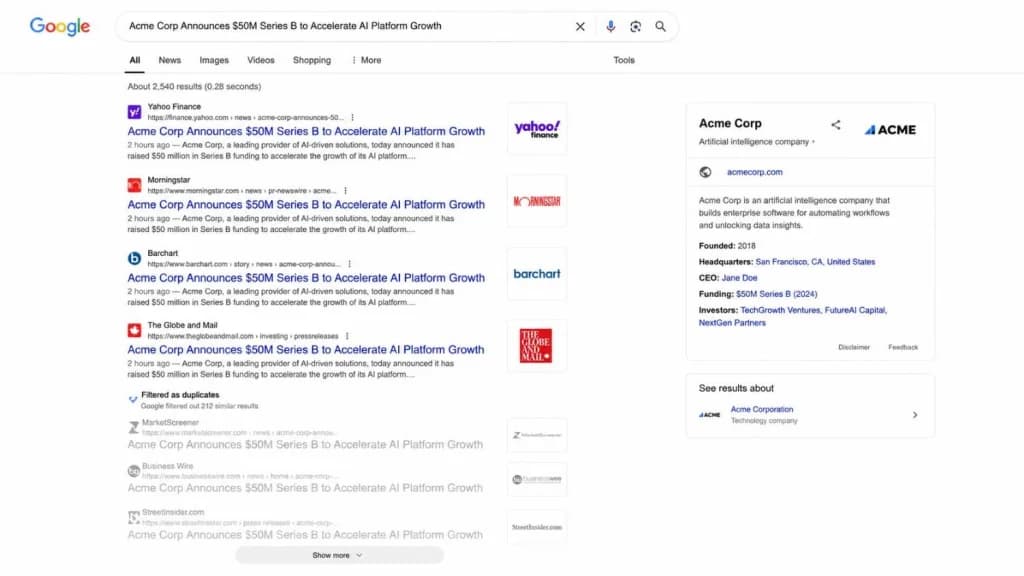
Here's the pattern we've watched repeat across thousands of releases. A client pays for distribution across multiple wire networks — the same release goes out to 200, 400, sometimes 500+ outlets. The media report looks spectacular. Then you search the headline in Google.
Google shows roughly four to five versions. In our experience, it's usually the same handful of high-authority syndication endpoints — Yahoo Finance, Morningstar, Barchart, The Globe and Mail — and everything else is filtered out of the results.
This isn't a glitch. It's exactly how Google says it works. When the same content appears at many URLs, Google's systems group the duplicates into a cluster and select one canonical version to show in search, with the rest treated as alternates. A press release syndicated verbatim across 400 sites is, to Google, one document with 399 duplicates.
There's a second problem stacked on top. Google's spam policies explicitly list links with optimized anchor text in press releases distributed across other sites as an example of link spam. So the "400 backlinks" a mass blast promises are mostly links Google either filters as duplicates or discounts as syndicated link placement. The domain authority math that makes a $99 blast look like a bargain rarely survives contact with how indexing actually works.
None of this means wire distribution is useless. It means it's a tool for a specific job — and most buyers are using it for the wrong job.
When a Mass Wire Blast Is the Right Choice
From what we've seen across 30,000+ placements, broad multi-wire syndication earns its cost in three situations:
Compliance and formal announcements. Law firms publishing class-action notices, companies announcing shareholder matters, M&A disclosures — anything where the record of wide distribution is the point, not readership.
Large-company marketing announcements. When a recognizable brand announces a new project, the wire blast functions as an amplifier for news that journalists would cover anyway.
Timestamp and official-record needs. Funding rounds and regulatory milestones where an indexed, dated wire record matters for investors and due diligence.
If your announcement fits one of these, an established wire service — GlobeNewswire, PR Newswire, Business Wire — is worth the fee, and reselling access (as we do with GlobeNewswire from $199) makes it accessible without the enterprise membership.
If it doesn't fit — and for most crypto projects, AI startups, SaaS tools, and small businesses, it doesn't — read the next section before spending anything.
The Smarter Budget Play: Individual Publications Over Blasts
Our standing advice to smaller companies is blunt: don't put a single piece of content on multiple wires. Choose the specific publications your audience actually reads, and buy those placements directly — a custom wire approach rather than a shotgun one.
The reasoning follows from the duplicate-filtering problem above. If Google is only going to surface 4–5 versions of your release anyway, paying for 400 syndicated copies buys you 395 URLs nobody will ever see. Redirecting that budget into a handful of distinct placements — a release on one wire, plus a bylined guest post on an industry site, plus an editorial feature — gives Google several unique documents to index instead of one document with hundreds of clones. Each placement stands on its own, ranks on its own, and passes value on its own.
It also matches how journalists behave. Cision's State of the Media research has found that the large majority of journalists receive dozens of pitches a week and say most of what lands in their inbox is irrelevant to their beat — a mass blast to a generic media list is exactly the noise they've learned to ignore. A release placed on the publication a journalist writes for, or a targeted pitch to a handful of relevant reporters, gets past that filter in a way volume never will.
The trade-off is honest: per-publication placement costs a little more per outlet than a blast costs per hundred outlets. It's also, in our experience, where the actual results live — real referral traffic, indexed pages that rank, and coverage you can screenshot without embarrassment. We covered which specific wires get picked up and cited by AI search engines in our guide to the best press release distribution options in 2026, which pairs well with this one.
Press Release Distribution in India: Wires vs. Editorials
Most affordable-PR guides are written for the US market and pretend India works the same way. It doesn't.
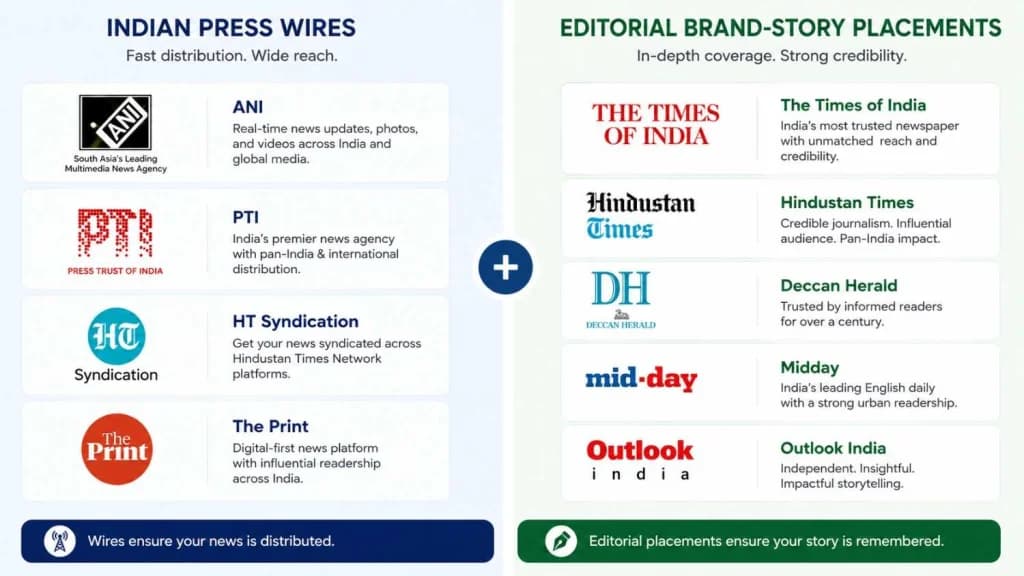
India's genuine wire layer is thin: ANI, PTI, HT Syndication, and The Print are effectively the wire options with real newsroom reach. There is no Indian equivalent of the crowded $49–$150 budget-wire tier — most of what's sold as "Indian PR distribution" at low prices is placement on low-traffic aggregator sites.
For visibility on the publications Indian readers actually recognize — Times of India, Hindustan Times, Deccan Herald, Midday, Outlook India — the working route isn't a wire at all. It's editorial: brand stories and sponsored features placed directly with the publication. These read as articles, live permanently on high-authority domains, and don't get duplicate-filtered because each one is unique content.
This is the gap TS Newswire was built across. Our network combines US wire access with direct editorial placement on Indian national publications — over 1,600 premium sites and growing — so a brand entering the Indian market can run a GlobeNewswire release for the official record and a Times of India brand story for actual audience reach, from one order.
How to Get Results From an Affordable Budget
Whatever tier you buy, four habits separate releases that earn pickup from releases that just exist:
Write news, not marketing. Funding, launches, partnerships, data. If the headline could apply to any company in your industry, rewrite it. Our complete guide to writing a press release in 2026 covers structure in detail.
Front-load the story. Journalists and AI systems both scan the first paragraph and move on. Who, what, why — in the first 60 words.
Optimize for AI search, not just Google. Releases increasingly get cited by ChatGPT, Perplexity, and Google AI Overviews. Named statistics, attributed quotes, and clean structure are what these systems extract — the discipline behind GEO.
Match the channel to the goal. Wire for the record. Editorial and digital PR for audience. Link building for SEO equity. One release rarely does all three jobs — a small budget split across the right channels beats a big budget dumped into one.
Where TS Newswire Fits
TS Newswire's model is per-placement pricing with everything visible before you pay. Inside the dashboard, every publication shows its DA/DR score, niche, turnaround time, and price — StreetInsider from $25, Barchart from $29, Business Insider from $150, Yahoo Finance from $169, GlobeNewswire wire distribution from $199 — across 1,600+ premium US and Indian publications.
That means you can act on everything in this guide from one place: run a wire release when the announcement calls for it, buy individual placements when it doesn't, and add Indian editorial coverage without hunting for a second vendor. No retainer, no discovery call, no quote to wait for.
Browse publications and pricing on the dashboard → or start with our press release distribution service.
Frequently Asked Questions
How much does press release distribution cost in 2026?
Budget wire services run $19–$150 per release, enterprise wires like PR Newswire ($350+) and Business Wire ($475+) serve corporate and investor-relations needs, and per-publication placement runs from about $25 (StreetInsider) to $199+ (GlobeNewswire wire access) depending on the outlet. For most small businesses, $100–$400 spent on 2–4 targeted placements outperforms the same amount spent on one mass blast.
Is cheap press release distribution worth it?
It depends on the job. A $49 blast is worth it when you need a wide, timestamped distribution record — compliance notices, formal announcements. It's rarely worth it for visibility, because Google filters syndicated duplicates and typically surfaces only 4–5 copies of the release, no matter how many outlets received it.
Why does my press release only show a few results in Google?
Google's indexing systems group identical content published at many URLs into a duplicate cluster and display one canonical version, treating the rest as alternates. A release syndicated to hundreds of sites is one document with hundreds of duplicates — in practice, only a handful of high-authority copies (often Yahoo Finance, Morningstar, Barchart) appear in search results.
Should a startup use a wire service or individual publications?
For most startups — especially in crypto, AI, and SaaS — individual publication placements deliver more. Pick the 3–5 outlets your audience reads, buy those placements directly, and reserve wire distribution for announcements where an official record matters, like funding rounds.
What are the press release wire options in India?
India's real wire layer consists of ANI, PTI, HT Syndication, and The Print. For coverage on major publications like Times of India, Hindustan Times, or Deccan Herald, the effective route is editorial brand-story placement directly with the publication rather than a wire — each editorial piece is unique content, so it indexes and ranks on its own.
Do press release backlinks help SEO?
Syndicated wire links carry limited SEO value — Google's spam policies specifically cite optimized-anchor links in distributed press releases as link spam, and duplicate copies get filtered. Links from unique editorial placements, guest posts, and earned coverage are where genuine SEO equity comes from.
Distribute your next announcement with named outlets
One-time pricing, compliance review for regulated industries, and a publication report with live links you can verify.