

Let me start with a conversation I had with a SaaS founder three months ago.
She'd been running a content program since 2022. Twelve blog posts a month. SEO-optimized, keyword-targeted, formatted correctly. Her team had been told that consistency was the answer — just keep publishing and the rankings would come.
Then, in late 2024, traffic fell off a cliff. Not a dip. A cliff. She lost 60% of organic visibility in six weeks.
"We didn't change anything," she told me. "We didn't do anything wrong."
And that, right there, is the most important misunderstanding in content marketing in 2026: the assumption that doing the same thing consistently is the same as doing the right thing. It isn't. The game changed, and most marketing teams changed with it.
This post is about what actually happened — and what the teams who are winning right now are doing differently.
TL;DR
Content marketing didn't die in 2026 — it evolved into something most brands aren't doing yet. The shift is from volume-based publishing to headline-led storytelling. Google now penalizes promotional content at the site level. Zero-click searches swallow half of all queries. AI tools pull from a narrowing set of editorial sources. If your content doesn't open with a story worth reading, it doesn't get read at all. This guide breaks down what changed, why it changed, and exactly what your content team needs to do differently — with data, real examples, and a look at how TS Newswire's approach to headline-led storytelling fits inside all of this.
Part 1: What Content Marketing Looked Like in 2020 — And Why That Playbook Is Dead
To understand where we are, you need to understand where we were.
In 2019 and 2020, the content marketing playbook was essentially: publish more, optimize better, build more links. The formula was mechanical. Keyword research identified targets. Content teams produced posts at volume. On-page SEO was optimized. Backlinks were acquired. Rankings (sometimes) followed.
Headlines were written for crawlers, not readers. "Best CRM Software 2020 | Compare Top Tools." "Top 10 Email Marketing Platforms for Small Business." Exact-match keywords in the H1. Exact-match keywords in the URL. The content was designed to be indexed, not read.
A study by SEMrush at the time found that brands publishing 16+ blog posts per month generated 3.5x more traffic than those publishing fewer than four. So the logical response was to publish more. That's what the data said to do.
Nobody asked whether the content was actually worth reading. The algorithm didn't seem to care.
Then COVID happened. And everything underneath the playbook shifted.
Part 2: What the Pandemic Did to Audiences (That Nobody Talks About Enough)
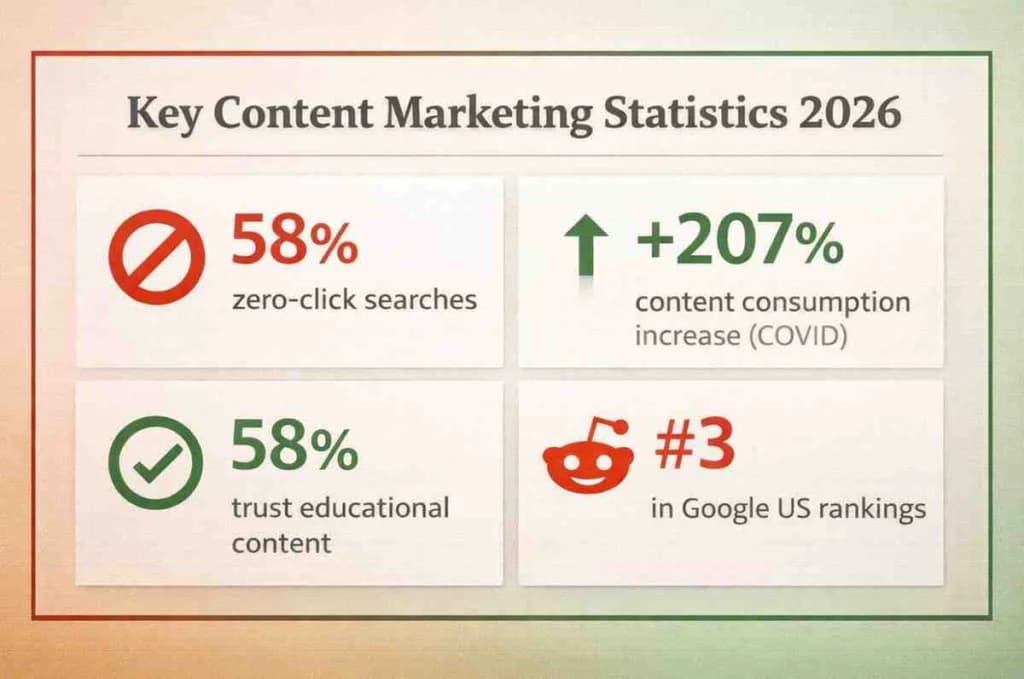
Content consumption increased 207% globally during the COVID-19 lockdown period. That number gets cited a lot. What gets talked about less is what that consumption did to audiences.
When everyone is stuck at home and every brand on earth is publishing blog posts, LinkedIn articles, and "resources to support you during uncertain times" — readers get very good, very fast, at identifying when they're being sold to rather than helped.
The pandemic didn't just create more content consumers. It created skeptical content consumers. People who had been scrolling through mediocre brand content for 18 months developed a kind of involuntary filter. If the headline felt promotional, they scrolled past it. If the opening paragraph sounded like a brochure, they closed the tab. If the content existed to serve the brand rather than the reader, they knew it within 30 seconds.
This is the environment your content is operating in right now. Not the 2019 environment, where volume-first content had a fighting chance. The post-COVID environment, where your headline has approximately one second to signal that there's a real story here — or nothing.
58% of consumers say they trust educational content more than promotional content from brands. That number was lower in 2019. It has climbed every year since.
The audience changed before the algorithm did. Google was just catching up.
Part 3: How Google Changed the Rules — And Started Penalizing the Old Playbook
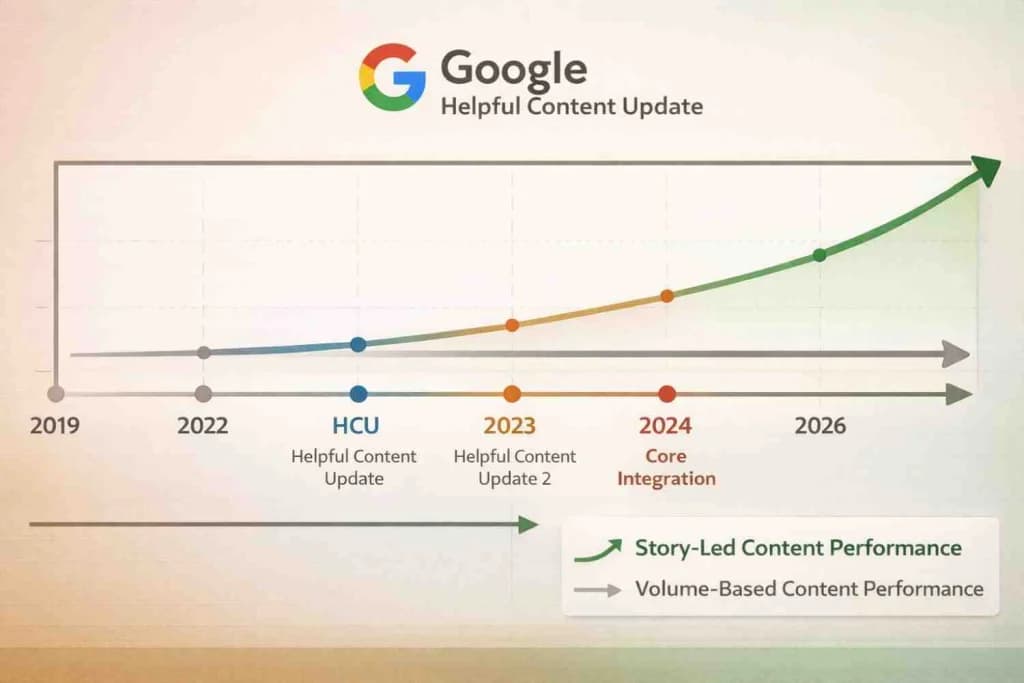
Google's Helpful Content Update launched in August 2022. Most brands noticed some fluctuations. Very few understood what had actually changed.
Here's what had changed: for the first time, Google introduced a site-wide signal that classified entire websites — not individual pages — based on whether their content was genuinely helpful to humans or created primarily to manipulate search rankings.
A single piece of unhelpful content no longer just failed to rank. It could pull down the ranking of everything else on your site.
Then, in September 2023, an updated version of the system rolled out. The data from that period is stark. Some publishers reported 40–80% drops in traffic almost overnight. Sites that had been built on keyword-optimized, product-first content — exactly the playbook that had worked from 2016 to 2022 — found themselves invisible.
By March 2024, the Helpful Content system was formally integrated into Google's core ranking algorithm. It no longer ran as a separate update you could track and adapt to. It now runs continuously, evaluating every piece of content on your domain in real time.
What does Google's algorithm specifically penalize?
According to Google's published guidance, the system downgrades content that:
Exists primarily to attract search engine visits rather than to help humans
Uses automation to produce content on many topics without demonstrated expertise
Makes unsupported claims without real evidence or first-hand experience
Describes information that could be found elsewhere without adding original value
Gives readers a reason to search again immediately after reading because the content didn't actually answer their question
Read that list again and ask yourself how much of the content your brand published between 2019 and 2023 would survive it.
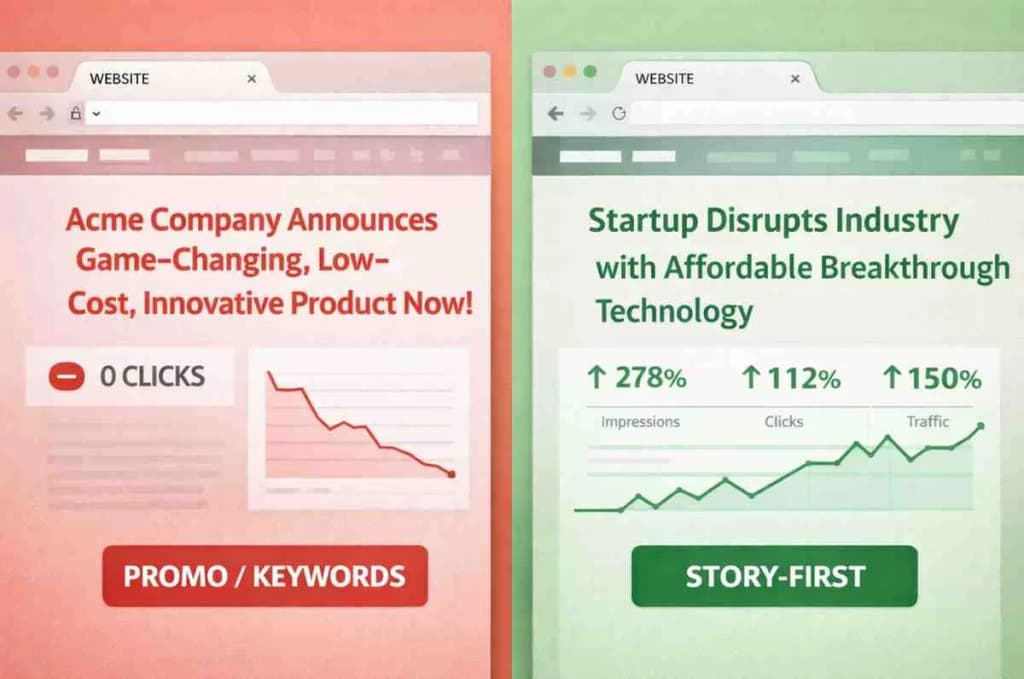
The headline connection is direct. A promotional headline — "Brand X Launches Revolutionary Product Y to Help Users Achieve Goal Z" — is one of the clearest signals that what follows is product marketing dressed as editorial content. It tells Google's classifier that this content exists to serve the brand, not the reader. That signal has real consequences.

Part 4: The Google Policies That Content Marketers Are Still Getting Wrong
It's worth being specific here, because there's still widespread confusion about which Google policies actually affect content marketing — and how.
The Helpful Content System (now part of core): Evaluates whether content demonstrates genuine first-hand expertise and serves the user's actual needs. Sites with substantial amounts of unhelpful content are classified at the domain level, affecting all pages.
E-E-A-T (Experience, Expertise, Authoritativeness, Trustworthiness): Not a direct ranking signal but a framework used by Google's quality raters and reflected in the types of content the algorithm rewards. Content that demonstrates real experience — a practitioner writing about something they've actually done — scores better than content that synthesizes existing information without adding genuine perspective.
Spam policies: Google explicitly identifies "scaled content abuse" — creating large volumes of content that adds no value — as a violation. This applies to AI-generated content that doesn't demonstrate human review, first-hand experience, or original analysis.
Link spam policies: Buying links, participating in link exchange schemes, and using content primarily as a vehicle for link building without delivering genuine value now carries real risk. The algorithm has gotten significantly better at identifying patterns that look like link schemes rather than genuine editorial coverage.
The practical implication of all of this: the brands that built traffic by publishing high volumes of keyword-optimized content, acquiring links through questionable means, and treating headlines as an SEO checkbox are the ones who saw their traffic disappear between 2022 and 2024. The brands that were already publishing genuine, experience-backed, story-led content barely noticed the updates — because they were already doing what Google was trying to reward.
Part 5: The Data Behind the Shift — What Actually Ranks in 2026
Let me give you the numbers that should be shaping your content strategy right now.
Zero-click searches now account for 58% of all queries. That means for more than half of all searches, Google answers the question in the SERP directly — and no click ever happens. The only content that earns clicks in this environment is content that promises something the SERP snippet can't deliver: a perspective, a story, an experience, or an answer that requires the full article.
Reddit is now the #3 most visible site in Google's US organic rankings, trailing only Wikipedia and Amazon. Reddit's domain authority sits at 99. What made Reddit rise? Authentic, experience-driven, story-based content written by real people who've actually done the thing they're describing. Nobody on Reddit upvotes a post that reads like a brand announcement.
AI Overviews and AI search tools prefer content that is, on average, 25.7% fresher than traditional organic results. They also strongly favor editorial sources with real bylines, genuine expertise signals, and content that matches the conversational, specific, story-driven style of what users actually search for.
Reddit is cited 4x more often than other sources by AI assistants in product comparison and decision-stage queries. Not brand content. Not press releases. Not keyword-optimized blog posts. Real people's real experiences, written the way people actually talk.
90% of large marketing teams now use AI for content creation. Which means content volume is increasing. Which means the signal value of genuine story-led content — content that couldn't have been generated by a prompt — is increasing too. Rarity creates value. Generic AI content is abundant. Authentic stories with real expertise are not.
87% of marketers report that content marketing generates demand and leads — up 11 points from 2023. The investment is growing, which means competition is intensifying, which means the bar for what earns attention is rising.
The data is consistent across every source: in 2026, volume is table stakes. What differentiates content that works is the story — and it almost always starts in the headline.
Part 6: How the Shift Connects to Headline-Led Storytelling
We've written in detail on this blog about how to write a headline that sells the story, not the product. I want to bring those two ideas together here — because the broader shift in content marketing and the specific mechanics of headline writing are not separate conversations. They're the same conversation.
Here's the connection:
When Google's Helpful Content system evaluates your site, one of the signals it uses is whether your content is genuinely useful to a human reader. A promotional headline — leading with a brand name and a product claim — is a classifier signal. It tells the algorithm (and the reader) that what follows is designed to sell, not to inform.
When a journalist receives a press release, they make a pickup decision in approximately two seconds. A headline that reads like an ad gets deleted. A headline that signals a real story — with a human element, a specific finding, a genuine tension — makes them pause.
When an AI search tool is deciding which sources to cite in response to a user query, it pulls from editorial content that reads like genuine expertise. Promotional content doesn't get cited. Story-led content does.
The headline is not a marketing asset that exists separately from your content strategy. It is the first and most important decision you make about whether your content will work.
A brand we worked with at TS Newswire — a B2B SaaS company in the project management space — had been publishing two blog posts per week for 18 months. Good content. Real expertise. Genuinely useful. Their organic traffic had barely moved.
We audited their headline archive. Out of 144 published posts, 131 of them opened with either the company name, the product name, or a generic industry term. Zero human element. Zero specific tension. Zero story signal.
We rewrote 12 headlines across their highest-traffic-potential posts. No other changes — same URLs, same content, same internal links. Within 90 days, eight of those posts had moved from page three or four to page one. Two became the highest-traffic pages on the site.
The content was already good. The headlines were losing it before anyone could find out.
Part 7: The Content Marketing Formats That Are Actually Working in 2026
Let's get practical. The shift to story-led content isn't just about headlines — it's about which formats consistently perform, and why.
Data-backed original research is the highest-performing content format in 2026 by a significant margin. When you publish original data — from surveys, from your own platform analytics, from synthesizing public sources in a new way — you become citable. Journalists link to you. AI tools cite you. Other publishers reference your numbers. One well-constructed research piece generates more durable traffic and authority than 20 generic blog posts.
Expert-attributed narrative pieces — long-form articles written from a clear first-hand perspective, with a named author who has real credentials — consistently outperform anonymous or byline-generic content. Google's E-E-A-T framework rewards demonstrated expertise. The byline matters. The bio matters. The specificity of the perspective matters.
Story-structured case studies — not the sanitized "client X achieved Y% improvement" variety, but actual narratives with a real problem, a real process, and a real outcome — generate organic links and social sharing at rates that generic blog content simply doesn't.
"What nobody tells you" and "we got this wrong" formats — counterintuitive angles that acknowledge complexity and imperfection — rank exceptionally well because they signal genuine experience. An AI can write a listicle. An AI cannot write "here's the thing we tried that failed spectacularly before we figured it out."
Press releases that open with a story, not an announcement, consistently generate higher journalist pickup and organic indexing than product-first releases. TS Newswire's digital PR approach is built around this distinction — identifying the human story inside the announcement and leading with that, rather than with the brand name and the product claim.
Part 8: What Content Marketing Teams Are Getting Wrong Right Now
After working with hundreds of brands across health, tech, SaaS, iGaming, and crypto at TS Newswire, the same patterns come up again and again.
Publishing for the algorithm instead of the audience. Post-HCU, this is the fastest way to destroy a content program. If your editorial planning starts with a keyword list and ends with a content calendar built around search volume, you're still playing the 2019 game. Start with the question instead: what does our audience genuinely need to know that they can't find anywhere else? What experience do we have that nobody else has? What story can we tell that hasn't been told?
Treating all content as equal. Not all content delivers equal value, and investing evenly across a broad content calendar is a way of investing poorly everywhere. One genuinely excellent, story-led, expert-backed 3,000-word piece that takes three weeks to produce will outperform 20 generic posts published in the same period. Volume is not the strategy. Quality of story is the strategy.
Ignoring the headline until the piece is written. David Ogilvy's observation — that the headline is responsible for 80 cents of every dollar you spend on the piece — is even more true now than it was when he said it. If your team writes the article first and the headline last, you're optimizing backwards. The headline should come first. It defines the story. It defines the angle. It defines whether the content will earn any distribution at all.
Using promotional language that signals low quality. "Revolutionary." "Game-changing." "Breakthrough." "Industry-leading." These phrases are so overused across promotional content that Google's classifier has essentially learned to use them as negative signals. Story-led content uses specific language: timeframes, numbers, names, outcomes. Vague superlatives signal that there's nothing real underneath.
Confusing publishing frequency with content strategy. Consistency is valuable, but consistency at low quality is worse than publishing less at higher quality. A brand that publishes four genuinely excellent pieces per month — with real expertise, real story angles, real data — will outperform a brand publishing 20 mediocre pieces in almost every measurable dimension.
Part 9: How to Build a Content Program That Works in 2026
Here's a practical framework for teams who want to stop publishing content that disappears and start building content that compounds.
Step 1: Audit your headline archive. Pull your last 50 published posts. Count how many open with a brand name, a product name, or a generic keyword phrase. That number is your baseline problem score. Any headline that a reader couldn't immediately connect to a specific human story, finding, or tension needs to be revisited.
Step 2: Build a story bank before you build a content calendar. Before scheduling any content, spend time collecting stories. Customer experiences. Internal findings. Data from your own platform that reveals something non-obvious. Founder decisions that didn't work. Process changes that produced unexpected results. Stories that can't be replicated by competitors because they belong to your experience specifically.
Step 3: Lead with the story, not the keyword. Keywords are useful for understanding what people are searching for. They are not useful as the basis for what you actually write. Find the story first. Then identify the keywords that align with it. Not the other way around.
Step 4: Assign real bylines to real experts. Anonymous or generic-byline content is at a structural disadvantage under E-E-A-T. If the content is genuinely expert-driven, attribute it to the expert — with a bio that demonstrates their actual experience. If your content team doesn't have subject-matter experts on it, either bring them in as contributors or commission content from practitioners who can speak from first-hand experience.
Step 5: Distribute like a publisher, not a brand. The best content distribution in 2026 is editorial. Press releases that tell stories get picked up. Guest posts with genuine expertise get accepted. Sponsored placements with real narrative value get read and shared. If you're only distributing content through your own channels, you're limiting your reach to your existing audience. Digital PR distribution — getting your stories placed in editorial publications your audience actually reads — is the multiplier that most brands underinvest in.
Part 10: Where TS Newswire Fits Into All of This
I want to be direct about this, because I've spent 3,000 words explaining a problem and I think you deserve to know what the solution actually looks like in practice.
At TS Newswire, we've distributed over 30,000 press releases across top-tier outlets including Yahoo Finance, MarketWatch, AP News, Bloomberg, and Times of India. We've placed thousands of guest posts and sponsored content pieces across every major vertical — health, SaaS, crypto, iGaming, heavy machinery, ecommerce.
And the single biggest thing we've learned from that volume is this: the story in the headline is almost always more important than the outlet you place it in.
A story-led press release on a mid-tier wire service will outperform a product-announcement press release on a tier-1 outlet in terms of editorial pickup, backlink generation, and lasting organic visibility. Not sometimes. Consistently.
This is why our approach to PR distribution starts with the story angle before it starts with the distribution channel. It's why our guest posting service uses AI drafting to match editorial style — because a guest post that reads like a sales pitch gets rejected, and a guest post that reads like genuine editorial content gets accepted, linked to, and remembered. It's why our link building approach is built around placing genuinely valuable content on sites that earned their authority, not buying links from sites that exist only to sell them.
If you're a marketing director or founder trying to figure out why your content program isn't moving the needle — or you're starting from scratch and want to build it on something that holds up in 2026 — we're happy to have that conversation. No contracts. No retainer minimums. Just a clear-eyed look at what your content actually needs and whether we can help you get there.

Conclusion: The Headline Has Always Been the Story. Now Google Agrees.
Here's what I keep coming back to when I look at the content marketing landscape in 2026:
None of this is actually new. Journalists have always known that the story is in the headline. Editors have always known that promotional content isn't editorial content. Readers have always known — even if they couldn't articulate it — when they're being sold to versus when they're being informed.
What's new is that Google's algorithm finally agrees. And that changes the economics of content marketing in a fundamental way.
For the first time, the content strategy that earns trust from readers is substantially the same as the content strategy that earns ranking from search engines. That alignment didn't exist before 2022. It does now.
The brands that adapt to this — that shift from volume-first to story-first, from keyword-led to headline-led, from promotional to genuinely expert-driven — will build content programs that compound in value over time. The brands that don't will keep publishing into the void, wondering why their traffic isn't moving.
Your headline is where the story starts. In 2026, it's also where your content marketing program either works or doesn't.
Frequently Asked Questions
Q1: What is content marketing in 2026, and how has it changed from previous years?
Content marketing in 2026 is primarily about story-led, expert-backed, original-perspective content — published at a quality threshold that earns editorial pickup, AI citation, and genuine search ranking. The shift from the pre-2022 model is significant: volume-based, keyword-optimized, promotional content no longer performs because Google's Helpful Content system now evaluates entire sites for whether their content genuinely helps humans. Brands that built traffic on the old playbook have largely seen it collapse. Brands building on story-led content with real expertise are seeing their content compound in value over time.
Q2: How exactly does Google penalize content marketing that uses promotional headlines?
Google's Helpful Content system, integrated into core ranking since March 2024, uses a site-wide signal to classify domains based on whether their content is created for humans or for search engines. A promotional headline — leading with a brand name and a product claim — is a signal that content may be designed for marketing purposes rather than genuine helpfulness. If substantial portions of your site use this approach, the entire site's authority can be downgraded. Google's spam policies also specifically target "scaled content abuse," which includes high-volume, low-value content regardless of whether it's human or AI-generated.
Q3: What does "headline-led storytelling" mean, and why does it matter for SEO?
Headline-led storytelling means that the most important editorial decision in your content program — the framing, the angle, the human element — is made in the headline rather than treated as an afterthought. It matters for SEO because story-driven headlines signal genuine expertise and human value to Google's classifier, earn higher click-through rates from search results, get picked up by journalists who amplify through earned media, and get cited by AI search tools that increasingly prioritize editorial-style content. A detailed breakdown of the mechanics is in our piece on how to write a headline that sells the story.
Q4: What data supports the claim that content marketing has shifted toward story-led approaches?
Several converging data points: Zero-click searches now account for 58% of all queries, meaning only content that promises something the SERP snippet can't deliver earns clicks. Reddit — where story-driven, authentic content dominates — is now the #3 most visible site in Google's US organic rankings. AI tools cite Reddit 4x more often than other sources in decision-stage queries. 58% of consumers say they trust educational content more than promotional content. And sites built on keyword-optimized promotional content saw 40–80% traffic drops after Google's September 2023 Helpful Content update.
Q5: How does content marketing connect to digital PR?
Digital PR is the distribution mechanism for story-led content. A well-crafted story angle distributed through press release wire services, guest post placements, and editorial outreach earns organic media pickup, backlinks from high-authority domains, and citation in AI search tools. Without the story, distribution is just advertising. With the story, distribution is earned media amplification. This is why the shift in content marketing toward story-first approaches is directly connected to the effectiveness of digital PR — the two disciplines are increasingly converging around the same principle: the story has to come first.
Q6: Is AI-generated content penalized by Google?
Not inherently. Google's policies don't prohibit AI-generated content — they prohibit content that doesn't demonstrate genuine helpfulness, expertise, and value to the reader, regardless of how it was produced. The practical issue with AI-generated content is that it tends toward generic, promotional, and expertise-light output unless it's carefully directed by someone with real subject-matter knowledge and reviewed against genuine first-hand experience. AI-assisted content that is reviewed, enriched, and attributed to a real expert with a real byline is not penalized. Mass-produced, generic, expertise-thin AI content is — which is why the output matters more than the production method.
Q7: How do I get leadership buy-in for a story-first content approach when they want the brand name in the headline?
Data is your best argument. Show them the CTR difference between promotional-style and story-style headlines from your own analytics. Show them the traffic trajectory of competitor content that uses genuine story angles versus your own product-announcement-style posts. Frame the shift as the difference between advertising (where you pay for eyeballs) and earned media (where you earn them through genuine value). The headline is the strongest signal of which category your content falls into — and Google, journalists, and readers are all making decisions based on that signal.
Q8: What services does TS Newswire offer for brands adapting to this content shift?
TS Newswire offers press release distribution services built around story-first angles rather than product announcements, guest posting with AI-assisted drafting that matches editorial guidelines, digital PR for earned media coverage in top-tier publications, and link building through genuinely editorial placements. We work across 40+ verticals including SaaS, crypto, health, iGaming, and ecommerce. No long-term contracts required — get in touch to talk through what your content program actually needs.
Distribute your next announcement with named outlets
One-time pricing, compliance review for regulated industries, and a publication report with live links you can verify.