


Key Takeaways
USCIS requires published material about you in professional or major trade publications — press releases and sponsored content do not qualify under 8 CFR § 204.5(h)(3)(iii).
EB-1A approval rates dropped to 66.6% in FY2025 Q3 — the lowest in three years — making evidence quality more critical than ever.
A single well-positioned editorial placement can support multiple EB-1A criteria simultaneously.
Coverage spread across 12 months before filing carries significantly more weight than a burst of pre-filing placements.
TS Newswire distributes to AP News, Yahoo Finance, MarketWatch, and Benzinga — publications that sit inside the trust network USCIS adjudicators recognise.
The TS guest post marketplace gives EB-1A applicants direct access to editorial placements across niche and authority publications — without retainer contracts.
Here is something most immigration attorneys do not emphasise clearly enough: your USCIS petition is only as strong as the evidence you can independently verify. Recommendation letters matter. Awards matter. But when it comes to the published material criterion, most applicants either underestimate what qualifies — or they mistake promotional content for evidence.
I have distributed over 30,000 press releases at TS Newswire across publications including AP News, Yahoo Finance, and MarketWatch. I have seen firsthand which formats USCIS accepts and which ones quietly kill petitions at the RFE stage. This guide cuts through the confusion.
What USCIS Actually Requires Under the Published Material Criterion
The regulation at 8 CFR § 204.5(h)(3)(iii) is specific. Published material must be about you — not your company, not your product launch — in professional or major trade publications, relating directly to your work in the field where you are claiming extraordinary ability. The documentation must include the title, date, author, and evidence of circulation or readership.
That last part is where most applicants trip up. USCIS adjudicators are trained to identify material that does not represent genuine third-party editorial judgment. If a journalist or editor at a recognised publication decided your contributions were newsworthy and wrote about them — that qualifies. If you paid for placement, wrote it yourself, or distributed a wire release that auto-populated on aggregator pages — it does not.
The October 2024 USCIS Policy Manual update made this even clearer. Adjudicators are now explicitly instructed to assess whether coverage represents genuine editorial interest in your contributions, or whether it was arranged and paid for.
What qualifies:
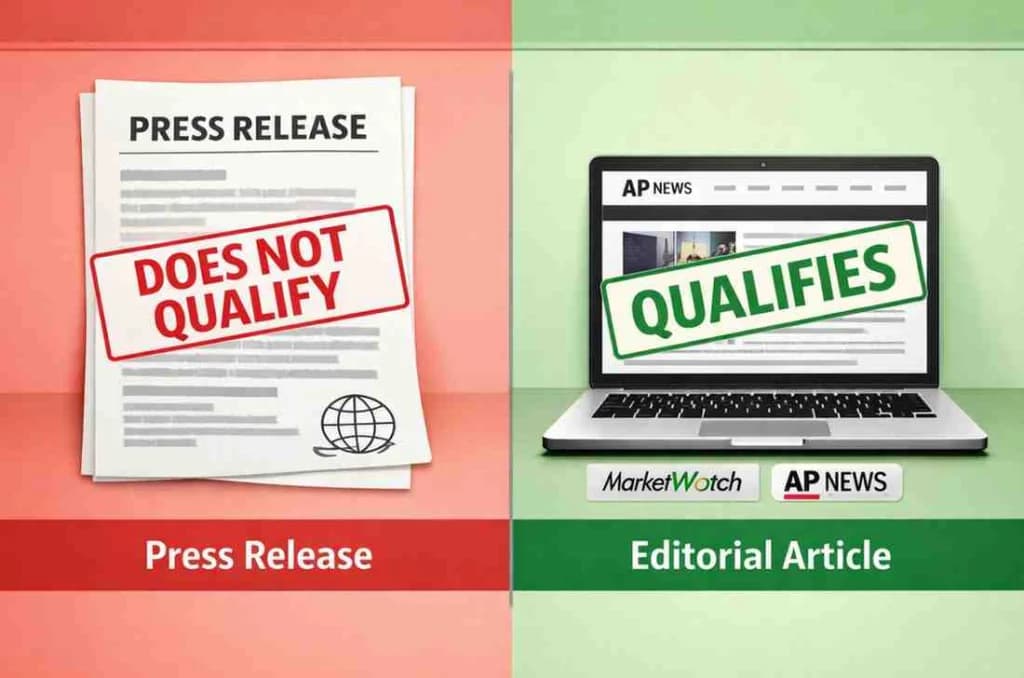
Articles authored by independent journalists at publications with professional editorial staff
Bylined features focused on your specific contributions to your field
Interview-based coverage in trade publications relevant to your discipline
News features in nationally recognised outlets (Forbes, Business Insider, Entrepreneur, AP News, MarketWatch, Yahoo Finance, Benzinga)
Archived, permanently accessible URLs with verifiable circulation data
What does not qualify:
Press releases and wire distributions (even when republished on major aggregator pages)
Sponsored content and advertorials
Self-authored contributed articles or op-eds written by you
Company profile pieces focused on products or services, not your personal contributions
Social media posts and newsletter mentions
The Current EB-1A Landscape — Why Evidence Quality Matters More Than Ever
The numbers have shifted significantly. According to USCIS FY2025 Q3 data (April–June 2025), the extraordinary ability category approval rate fell to 66.6% — the lowest quarterly rate in three years. The denial rate rose to 33.4% in the same period, up from 25.1% just two quarters earlier. RFE (Request for Evidence) rates are running at an estimated 40–50%, the highest in several years.
What is driving this? Adjudicators are applying closer scrutiny at the subjective "final merits" stage of the Kazarian two-step framework — and the published materials criterion is one of the first places they look. Vague accomplishments, self-reported impact metrics, and low-authority media mentions are being challenged more aggressively than in prior years.
Petitions supported by high-authority editorial placements — genuine coverage in Forbes, Business Insider, or field-specific trade journals — achieved approval rates exceeding 75% even during this tightening period. The outlet matters as much as the article.
Disclaimer: TS Newswire is a digital PR and press release distribution agency, not an immigration law firm. This article is for general informational purposes only and does not constitute legal advice. Always work with a qualified immigration attorney to develop your EB-1A petition strategy.
Which Publications Actually Count — and Which Ones Waste Your Time
Not all media placements are equal in USCIS's eyes. The standard is "professional or major trade publications or other major media" — a phrase that has been interpreted through years of adjudications to mean outlets with professional editorial staff, verifiable readership, and national or international recognition.
Strong EB-1A publication categories:
General business authority: Forbes, Entrepreneur, Inc. Magazine, Fast Company, Business Insider, Fortune. These publications are recognised by USCIS adjudicators as major media. A single well-positioned editorial feature in any of these can directly satisfy Criterion 6.
Wire-syndicated news outlets: AP News, Yahoo Finance, MarketWatch, Benzinga. These carry high trust signals precisely because they operate through editorial gatekeeping rather than open submission. TS Newswire distributes directly to all four. A press release that earns genuine editorial pickup (not just syndication) on AP News is substantively different from a wire release that generates aggregator copies.
Field-specific trade publications: For science and technology professionals — Wired, MIT Technology Review, IEEE publications. For healthcare — Modern Healthcare, STAT News. For finance — Bloomberg, Financial Times regional editions. For AI/tech founders — VentureBeat, TechCrunch. The field-specific dimension matters because USCIS requires coverage to relate to your field of extraordinary ability, not just your general professional existence.
What about press releases specifically? This is where many EB-1A applicants get confused — and where the distinction between TS Newswire and a basic wire service becomes meaningful. A press release distributed to 200+ outlets does not constitute "published material" in the USCIS sense, because it originates with you rather than representing independent editorial judgment. However, a strong press release distributed through credible outlets can generate editorial coverage — journalists who read wire pickups on AP News and find a genuinely newsworthy angle will write about it. That secondary editorial coverage does qualify. The press release is the trigger; the editorial follow-up is the evidence.
For a detailed breakdown of how press release distribution works in the AI era — including which outlets ChatGPT, Gemini, and Perplexity actually cite — that guide covers the full landscape.
One Placement Can Support Multiple EB-1A Criteria
This is one of the most underutilised aspects of media strategy for extraordinary ability petitions. EB-1A requires applicants to meet at least 3 of 10 criteria. A strategically framed editorial article can support more than one criterion simultaneously, depending on content and angle.
Article angle | Primary criterion satisfied | Also strengthens |
|---|---|---|
Feature on your methodology or field innovation | Criterion 6 — Published Material | Criterion 5 — Original contributions of major significance |
Profile on your leadership of a recognised initiative | Criterion 6 — Published Material | Criterion 8 — Critical role in a distinguished organisation |
Interview where you evaluate industry trends or peers' work | Criterion 6 — Published Material | Criterion 4 — Judging the work of others in your field |
Multiple placements across 12–18 months | Criterion 6 — Published Material | All criteria — Demonstrates sustained national acclaim |
The framing of each article matters as much as where it is published. A journalist profile that focuses on your company's revenue numbers is weaker than one that frames you as the innovator behind a specific methodology your field now references. Your immigration attorney and your PR strategy should align before any pitching begins.
For a broader view of how personal brand PR works for founders and independent experts — including how coverage compounds over time — that article covers the underlying mechanics in detail.
The 12-Month Media Strategy: Building Evidence Over Time
USCIS adjudicators are experienced enough to recognise a manufactured publicity burst. Coverage clustered immediately before filing looks orchestrated. Sustained coverage across 12 months demonstrates the kind of ongoing national or international recognition the extraordinary ability category actually requires.
Month 1–3: Establish your narrative Your first placement defines your public-facing story of expertise — who you are, what your field is, what makes your contributions significant. Every subsequent article builds on this anchor. This is the most important piece to get right, and it requires coordination between your immigration attorney and your PR strategy before any pitch goes out.
Month 3–9: Build sustained recognition across multiple outlets Coverage from a single publication, however prominent, tells a thinner story than coverage from multiple independent editorial sources. This phase adds 3–5 placements across different credible outlets. Spacing placements 4–8 weeks apart creates a pattern of sustained recognition rather than a one-time spike.
Month 9–15: Add field-specific depth USCIS requires coverage to relate specifically to your field of extraordinary ability. Trade journals and specialist publications directly relevant to your discipline carry different evidentiary weight than general business media — they demonstrate recognition from the professional community you are claiming to be extraordinary within.
Month 15–18: Allow a quiet period before filing Immigration attorneys consistently advise against new placements in the final 4–6 weeks before petition submission. Let your media record stand on its own. The goal is a portfolio that looks organically earned over time — because the strongest cases are built exactly that way.

How the TS Guest Post Marketplace Helps EB-1A Applicants
This is where TS Newswire's guest post infrastructure becomes directly relevant to EB-1A strategy.
The TS guest post marketplace gives you access to a vetted network of editorial publications across business, technology, finance, health, and niche verticals — without agency retainers, without lock-in contracts, and without the $2,000–$6,500 price tags that dedicated visa PR services charge.
Here is how the workflow fits an EB-1A strategy:
Browse by domain authority and niche. The marketplace lists placements by DR, traffic, and topical relevance. For EB-1A purposes, you can filter toward publications that genuinely sit within your field — which satisfies the "relating to your work in the field" requirement more specifically than a generic business publication.
Commission editorial articles, not sponsored posts. TSViveMedia connects you with writers and editors who produce bylined editorial content — the format USCIS recognises as independent third-party validation. Sponsored labels disqualify placements; editorial bylines do not.
Build a portfolio across multiple outlets. Rather than paying one service for five placements at a fixed price, you can construct your 12-month evidence portfolio incrementally — adding placements as your strategy evolves, in coordination with your attorney's filing timeline.
Start at $199. TS Newswire's press release distribution starts at $199. Guest post placements through TSViveMedia are priced transparently per placement — no retainer, no minimum commitment. For international founders building US credibility alongside a visa strategy, this model is significantly more accessible than agency alternatives.
For context on what this looks like for international-based founders specifically, the breakdown on building US brand credibility from the UK, India, or UAE maps this exact gap.
Important: TSViveMedia placements should be reviewed by your immigration attorney before inclusion in any visa petition. Not every guest post automatically qualifies as USCIS published material — the editorial independence, outlet authority, and article framing all need to meet the evidentiary standard your attorney is building toward.
The Press Release's Real Role in an EB-1A Strategy
Press releases do not directly satisfy the published material criterion. But dismissing them entirely misses how EB-1A evidence actually gets built in practice.
A press release distributed through TS Newswire to AP News, Yahoo Finance, MarketWatch, and Benzinga achieves two things. First, it establishes a timestamped public record of your announcement — useful for demonstrating that your recognition exists on the public record at a specific moment in time. Second, and more importantly, it puts your news in front of working journalists who may find the angle genuinely interesting and write about it independently. That second outcome is where USCIS-qualifying evidence can be generated.
For founders in AI, crypto, SaaS, and health — TS Newswire's verticals — press releases also feed the AI citation ecosystem. Between July and December 2025, press release citations in AI tools like ChatGPT, Gemini, and Perplexity grew significantly. Building a public record across trusted outlets also supports GEO (Generative Engine Optimisation) — your name appearing in AI-generated summaries of your field is increasingly relevant evidence of ongoing recognition.
For a full breakdown of which AI tools cite press releases and how distribution strategy affects AI visibility, that guide goes deep on the mechanics.
What to Do Before Engaging Any PR Service for Your EB-1A
A few practical steps that will save you time, money, and potential petition damage:
1. Build your media strategy with your immigration attorney first. PR firms — including TS Newswire — are not immigration lawyers. The angle, framing, and outlet selection for your EB-1A placements should be reviewed through a legal lens before any article goes live. A placement that looks impressive to a general audience might frame your contributions in a way that weakens your petition rather than strengthening it.
2. Verify editorial independence before claiming a placement as evidence. If you paid for the article directly, if your byline is on it, or if it carries a sponsored label — it does not qualify. Ask the PR service to confirm in writing that each placement is authored by an independent journalist through the outlet's standard editorial process.
3. Document everything. USCIS documentation requirements for published material include the title, date, author, and circulation data. Collect full screenshots, archived PDFs, and Wayback Machine captures for every placement. Do not rely on live URLs alone — publications occasionally reorganise content.
4. Start 12–18 months before your intended filing date. The evidence you need cannot be built in a week. If you are within 90 days of filing and have no media coverage, an immigration attorney should assess whether a stronger pre-filing evidence period is worth the delay.
Frequently Asked Questions
Does a press release count as published material for EB-1A?
No. Under 8 CFR § 204.5(h)(3)(iii), USCIS requires independent editorial coverage — material authored by journalists through an outlet's standard editorial process. Press releases originate with the subject and are distributed on their behalf, so they do not represent the third-party editorial judgment USCIS looks for. However, a well-targeted press release can generate editorial coverage from journalists who pick up the angle — and that secondary coverage does qualify.
What publications qualify as "major media" for EB-1A purposes?
Qualifying outlets include nationally and internationally recognised publications with professional editorial staff and verifiable readership. For business and entrepreneurship: Forbes, Entrepreneur, Inc., Fast Company, Business Insider. For technology: Wired, TechCrunch, VentureBeat, MIT Technology Review. Wire-syndicated outlets with genuine editorial processes — AP News, Yahoo Finance, MarketWatch — also carry significant weight. Field-specific trade journals relevant to your discipline are often equally persuasive for the "relating to your field" requirement.
Can sponsored content or guest posts qualify for EB-1A?
It depends entirely on the format. Sponsored content and advertorials — marked as paid placement — do not qualify because they represent your voice, not independent editorial judgment. Editorial guest posts, where an outlet's editorial team commissions and edits the piece and it carries no paid or sponsored label, exist in a grey area that your immigration attorney should assess. The strongest evidence is always journalist-authored, third-party editorial content where you are the subject rather than the author.
How many media placements do I need for EB-1A?
USCIS does not specify a minimum. Immigration attorneys consistently advise that 3–5 placements in nationally recognised, Tier-1 publications are substantially more persuasive than 20 mentions across low-authority outlets. Quality and outlet credibility determine evidentiary weight more than quantity.
How does TS Newswire distribution help with EB-1A evidence?
TS Newswire distributes to AP News, Yahoo Finance, MarketWatch, and Benzinga — publications that carry genuine editorial authority and are indexed across the trust networks USCIS adjudicators and journalists reference. Distribution does not directly create USCIS-qualifying evidence, but it puts your news in front of journalists who may independently cover it, and it establishes a verifiable public record of your recognition at a specific moment in time.
When should I start building EB-1A media coverage?
Start 12–18 months before your intended filing date. Immigration attorneys recommend a phased approach: establish your narrative with a first anchor placement (months 1–3), build sustained recognition across multiple outlets (months 3–9), add field-specific depth through trade publications (months 9–15), and allow a quiet period in the final weeks before filing (months 15–18). Coverage published immediately before submission appears orchestrated and carries less evidentiary weight.
Does the TS marketplace offer placements that qualify for EB-1A?
TS Marketplace connects you with editorial placements across a vetted network of business, technology, and niche publications. Whether a specific placement qualifies as USCIS published material depends on the editorial independence of the outlet, the article framing, and how the placement is documented — your immigration attorney should review each piece before it is included in a petition. TS Marketplace is a practical tool for building a 12-month media portfolio incrementally; it is not a substitute for immigration legal strategy.
Distribute your next announcement with named outlets
One-time pricing, compliance review for regulated industries, and a publication report with live links you can verify.