

Quick answer
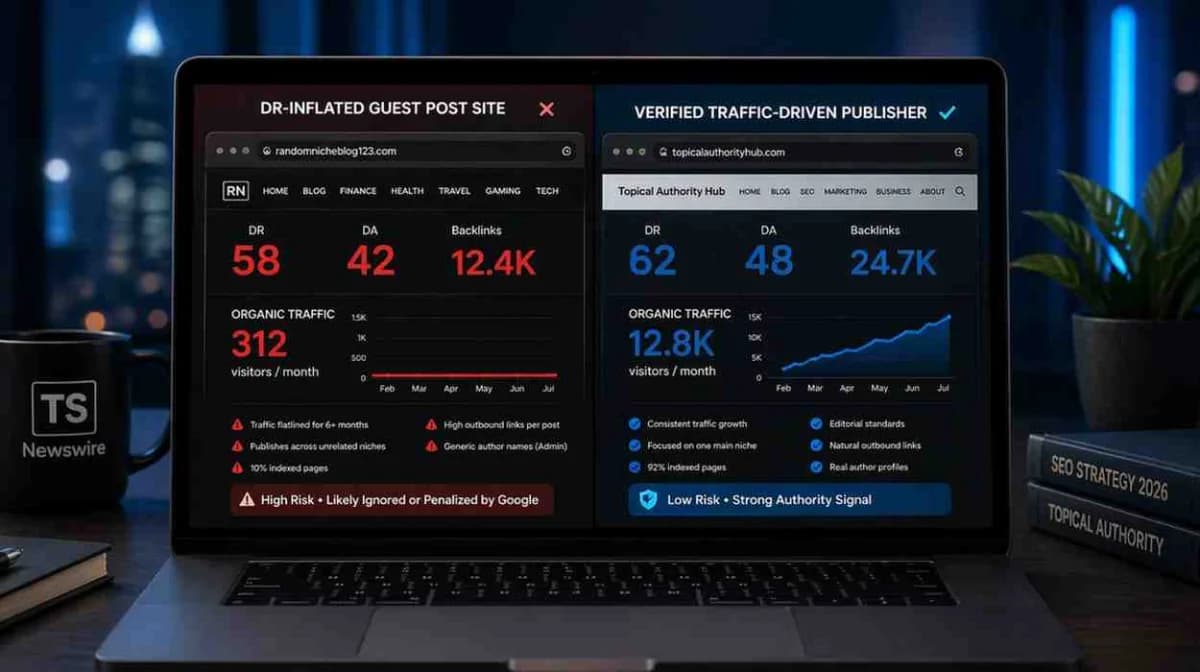
A large portion of sites on guest post marketplaces have artificially inflated DR/DA with near-zero organic traffic. Google's 2025 spam and site reputation abuse updates now actively penalise links from these sites — not just ignore them.
The guest posts that move rankings in 2026 come from sites with real audiences, topical relevance, and editorial standards. DR and DA are not enough. Traffic quality, niche consistency, and index health matter more.
If you want placements that actually work, you need a marketplace that filters these sites out before you ever see them. That's exactly what TS Newswire's guest post marketplace is built to do — with verified publisher metrics across 40+ verticals, no link farms, no DR theatre.
Let's Be Honest About What's Actually Being Sold
Here's a scenario that plays out hundreds of times a day in the guest post industry. A brand searches for guest post placements. They find a marketplace. They filter by DR 40+. They see dozens of options at $50–$150 per placement. They buy a few. Nothing moves.
The sites they bought on had a DR of 52. They also had 310 monthly organic visitors, most of them from tier-3 traffic arbitrage. The "blog" published content across fintech, health, travel, gaming, and pet care — often in the same week. The site exists to sell links. That's it.
This isn't a fringe situation. It's the dominant model in the guest post marketplace space right now. And the brands getting burned are often doing everything right except one thing: trusting DR and DA as proxies for quality when they haven't been reliable signals of real authority for years.
Understanding Domain Rating (DR) and Domain Authority (DA) is important context here — both are third-party metrics, not Google signals. They measure backlink profiles, not actual editorial trust or ranking ability. And backlink profiles can be bought.

The DR Inflation Playbook (And How Widespread It Is)
The manipulation cycle that powers most of these sites follows a pretty predictable script.
Someone buys an aged domain or registers a fresh one. They spend a few hundred dollars on bulk backlinks from PBN networks or link exchanges — enough to push Ahrefs DR from 8 to 45 in 60 days. They build out a thin blog across multiple unrelated niches to appear like a "general publication." They list the site on guest post marketplaces claiming editorial placement at a discount price. Buyers come in, publish articles, get a dofollow link, and wait for rankings to move. They don't.
The core problem: Google doesn't rank these sites for anything meaningful. There's no real audience clicking through. The link you bought exists on a domain carrying a high-risk footprint — one that Google's algorithms associate with link scheme patterns and can lead to domain-wide demotion signals. Officially, Google says it "ignores" spammy links. What that looks like in practice, across thousands of audited sites, is traffic that flatlines even as link counts rise. Your money went to someone else's metric arbitrage.
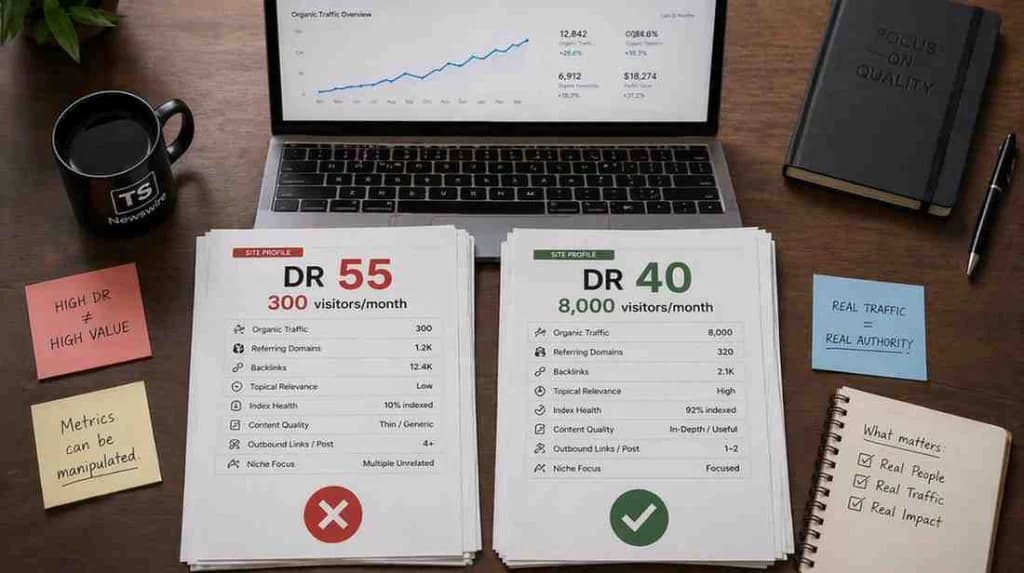
The tell-tale signs of this pattern are consistent across thousands of sites. A DR that jumped 30+ points in under 90 days is almost always purchased, not earned. A site publishing across 8 unrelated verticals with the same posting frequency is a content farm, not a publication. A site with DR 55 and 400 monthly organic visitors failed Google's quality bar — and any link it gives you carries that failure.
Red Flags: A Site Is Probably DR-Inflated
DR 40+ but under 1,000 monthly organic visitors from tier-1 countries
DR jumped more than 20 points within a single quarter
Content published across 5+ unrelated niches (tech, health, travel, finance, gaming)
High outbound link count per post — often 3–5 commercial links per article
Author bylines are generic ("Admin," "Guest Contributor," no real profile)
Only 10–15% of published pages are indexed by Google
Zero social engagement — no shares, comments, or community signals
Traffic source is predominantly direct or social with minimal organic search
What Google Has Actually Done About This (2024–2026)
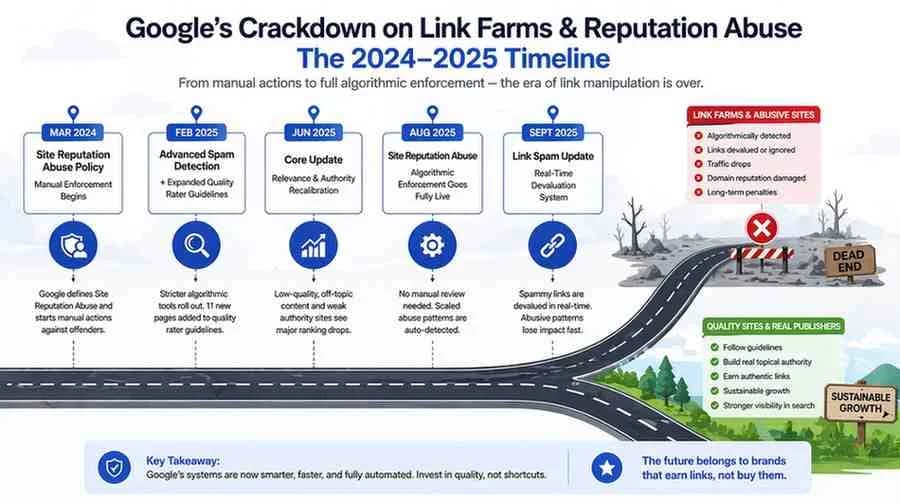
This isn't a theoretical future problem. Google has spent the last two years systematically dismantling the economics of link-farm guest posting. Here's what happened, in order:
March 2024
Site Reputation Abuse Policy — Manual Enforcement BeginsGoogle formally defined "Site Reputation Abuse" as hosting third-party content primarily to manipulate rankings rather than serve a real audience. Initial enforcement was manual — human reviewers issuing actions against the most egregious offenders.
February 2025
Advanced Spam Detection + Expanded Quality Rater GuidelinesGoogle rolled out stricter algorithmic tools for detecting scaled content abuse. The quality rater guidelines expanded by 11 pages focused specifically on identifying manipulative third-party content patterns.
June 2025
Core Update — Relevance & Authority Enforcement TightensLinks from topically irrelevant or low-authority sites stopped passing meaningful value at scale. Sites seeing 30–50% organic traffic swings were predominantly those relying on link-farm-style guest post networks.
August 2025
Site Reputation Abuse — Fully AlgorithmicWhat started as manual enforcement in March 2024 is now built into the core algorithm. Sites hosting content primarily for third-party link value face ranking demotions without any manual review needed. This is the update that closed the loop on the old guest post farm model.
September 2025
Expertise & Authenticity Core UpdateReinforced E-E-A-T signals across the board. Real author credentials, demonstrated first-hand experience, and original data became stronger ranking factors. Generic guest posts with no real author identity get no benefit.
The pattern is consistent across every update: Google is not going softer on link schemes. It's getting better at detecting them. And the window between "this works" and "this gets you penalised" is now measured in months, not years.
The Numbers That Should Make You Rethink Your Last Three Placements
92% of marketers confirmed guest post backlinks remain a top-3 ranking factor — but only from genuinely authoritative sources. (Semrush, 2024)
The demand for guest posting is real and the SEO value is real. But it's conditional on the quality of the placement. That same Semrush data found that pages with high-quality backlinks from relevant domains are 3.8x more likely to rank in the top three search results.
73% of sites audited across common guest post marketplaces had under 1,000 monthly organic visitors from tier-1 countries — despite DR scores of 35 or higher. (TS Newswire internal publisher audit, 2026)
58% of all Google searches are now zero-click, primarily affecting informational queries. Guest posts are still a strong backlink play — but they need a real audience to also earn referral traffic. (SparkToro / Datos, 2024)
This matters even if your primary goal is link authority. If the publication has no real readership, your placement has exactly one job: passing a link. And if that site carries a high-risk footprint from Google's perspective, that link passes little value — or none.
To be fair: not all marketplaces are junk. A more precise framing is that most suffer from a structural quality problem rooted in misaligned incentives — which is exactly what we'll cover next. The good placements exist; they're just harder to find at scale without a verification layer. The guest posts that justify their cost in 2026 build backlink authority and reach a real audience simultaneously — you only get both from sites with genuine editorial standards.
What a Quality Guest Post Placement Actually Looks Like
Let's get specific, because "quality" is thrown around constantly in this industry and usually means nothing.
A guest post placement worth buying in 2026 has these characteristics — and you should be able to verify all of them before you pay:
What a Verified Quality Placement Looks Like
Real organic traffic: Minimum 1,000–5,000 monthly visitors from tier-1 countries (US, UK, AU, CA), verified through Ahrefs or Semrush — not self-reported
Topical relevance: The publication's primary focus matches your niche. A SaaS company getting a link from a travel blog is not a quality placement
Healthy DR-to-traffic ratio: DR 45 with 8,000 monthly visitors is credible. DR 55 with 400 visitors is manipulated
Editorial standards: The site has a real editorial process — they reject content that doesn't serve their audience, not just content that fails grammar checks
Indexed content: 70%+ of published pages are indexed by Google (check via site: operator)
Real author bylines: Content is attributed to named individuals with verifiable credentials or social profiles
Natural link profile: The site earns links from other real publications — not just from guest posts on other link farms
Most marketplaces don't verify any of this. They list sites based on self-reported DR and a flat fee to the publisher. The incentive structure rewards quantity of listings, not quality. That misalignment is exactly what creates the problem buyers keep running into.
Why Most Marketplaces Can't Fix This On Their Own
Here's the structural issue that nobody in the marketplace space talks about: most platforms earn commission per transaction. Filtering out low-quality sites reduces their inventory and reduces their revenue. There's no commercial incentive to get stricter — until the entire category loses credibility.
There's also an "adverse selection" problem that makes this worse over time. Good publishers — the ones with real editorial standards and genuine traffic — often leave open marketplaces because they don't want to be listed alongside link farms. The quality bar of the marketplace feels like a reputational risk to them. So they exit, leaving behind an increasingly concentrated pool of sites that exist primarily to sell links. The marketplace's average quality degrades without anyone making an active decision to let it happen.
That's starting to happen visibly. Brands that have been burned by inflated placements are either abandoning guest posting entirely — missing real SEO opportunities — or building internal vetting processes that are time-consuming and tool-intensive. Neither is a good outcome.
The market needs a marketplace where the business model rewards quality over quantity. Where verification happens before listing, not after a complaint. Where buyers can see real traffic data, real niche focus, and real indexing health — not just a DR score and a price.
TS Newswire Filters the Sites You Shouldn't Be Buying From
Our guest post marketplace verifies organic traffic, DR-to-traffic ratios, topical consistency, index health, and outbound link patterns before any site gets listed. You see publishers that have passed our audit — not the full, unfiltered internet with a DR filter slapped on top.
40+ verticals. Transparent publisher metrics. No link farms. Real traffic data, not metric theatre.
See traffic-verified publishers — before you spend another $100 on DR guesswork →
The Five Checks to Run Before Any Guest Post Purchase
Even if you're not using a verified marketplace, you can do a basic audit before you commit budget. These five checks take about 15 minutes per site and will filter out most of the junk.
1. Run the DR-to-Traffic Ratio Check
Open the site in Ahrefs or Semrush. Look at organic traffic. If a DR 45+ site is pulling under 1,000 monthly organic visitors from English-speaking markets, stop there. The DR was bought, not earned.
2. Check the Site: Index Count
Go to Google and search site:domain.com. A site with 2,000 published posts but only 150 indexed pages has been sandboxed, hit by a penalty, or is producing content Google considers worthless. Either way, your link lives in that environment.
3. Look at Niche Consistency
Scroll through the last 30 published posts. If they span health, gaming, finance, travel, and cryptocurrency with no editorial throughline, you're looking at a link farm that happens to have a decent DR. Topical authority — which is how Google evaluates relevance signals — doesn't exist on a scatter-shot blog. Check the topical authority glossary entry for more on why this matters for link building strategy.
4. Check the Outbound Link Density
Click into three or four recent articles. Count the commercial outbound links per post. If every post has 3–5 links pointing to different businesses with keyword-rich anchor text, the site's primary revenue stream is link selling. Google's quality raters flag this pattern explicitly. So does Google's algorithm.
5. Verify the Backlink Profile Quality
Look at who links to the site — not just how many links it has. If the referring domains are mostly other low-traffic blogs, PBN-looking sites, or irrelevant international domains, the DR was manufactured. Real authority sites earn links from real publications in their niche.
If a site passes all five of those checks, it's worth considering. If it fails on two or more, move on regardless of the DR and price.
What This Means for PR and Guest Posting Together
One thing that's become clear in 2026 is that the best link-building strategies don't rely on guest posting alone. The brands seeing the strongest authority growth are combining editorial guest posting with genuine Digital PR — earned media coverage in real publications, not paid placements dressed up as editorial.
The distinction matters because Google's algorithm and AI search engines evaluate link sources differently depending on context. A editorial link from a journalist who covered your brand because the story was genuinely interesting carries more trust weight than even the best guest post placement. Not because guest posts are inferior — but because the editorial independence signal is stronger.
The practical upshot: use guest posting to build niche authority, establish bylines, and earn contextual links from relevant publications. Use PR and press release distribution services to land coverage in tier-1 publications that creates the kind of brand signal no amount of guest posting can replicate. The two strategies compound — each makes the other more effective.
2023 vs 2026: How Guest Posting Has Actually Changed
If you're running a strategy that was built two or three years ago, here's a side-by-side of what's changed — and what it means for your next placement decision.
Dimension | 2023 playbook | 2026 reality |
|---|---|---|
Primary metric | DR / DA score | Organic traffic + DR ratio |
Volume strategy | More placements = more links = better rankings | Fewer, higher-relevance placements outperform |
Niche relevance | Nice-to-have | Non-negotiable — irrelevant links devalued |
Author byline | Generic "Guest Contributor" acceptable | Real credentials required for E-E-A-T |
AI search value | Not a consideration | Editorial placements get cited by AI Overviews |
Risk of bad placement | Link just doesn't help much | Domain-wide demotion risk from site reputation abuse |
Frequently Asked Questions
Is guest posting still worth it in 2026?
Yes — but only on sites with genuine organic traffic and editorial standards. Guest posts on DR-inflated, low-traffic sites now carry no SEO benefit and may trigger Google's link spam filters. Quality placements on topically relevant, traffic-verified sites remain one of the strongest authority signals available, with Semrush data showing pages with high-quality relevant backlinks are 3.8x more likely to rank in the top three results.
How do sites artificially inflate their DR or DA?
By purchasing backlinks from PBN networks or link exchanges to push Ahrefs DR or Moz DA from single digits to 40–60+ in a matter of weeks. The metric rises because it's based on backlink profiles, not actual Google performance. The site never earns real organic traffic because Google doesn't rank it for genuine queries — which is why the DR-to-traffic ratio is such a reliable fraud detector.
What does Google's Site Reputation Abuse policy mean for guest posting?
It means sites that host third-party content primarily to pass ranking signals — rather than serve a real audience — now face algorithmic ranking demotions. This went from manual enforcement in March 2024 to fully algorithmic after the August 2025 Spam Update. Sites hosting content across unrelated niches without genuine editorial oversight are squarely in the crosshairs.
How can I quickly check if a site has fake DR?
The fastest check: compare DR to monthly organic visitors in Ahrefs or Semrush. DR 45 with 300 monthly visitors = almost certainly manipulated. Also check how quickly the DR rose — a 30-point jump in under 90 days is a near-certain signal of purchased links. Then look at niche consistency and the site:domain.com index count in Google.
What's the difference between a guest post and a PR placement?
A guest post is a bylined article you pitch and write for a third-party publication, typically with a contextual link back to your site. A PR placement is earned media — a journalist covers your brand based on a story, data, or announcement without you writing the content. Both build authority, but PR placements carry stronger editorial independence signals. The two strategies work best together rather than as alternatives. See our Digital PR glossary entry for more detail.
How does TS Newswire's guest post marketplace filter low-quality sites?
Publishers go through a verification process before listing that checks: minimum organic traffic thresholds from tier-1 markets, DR-to-traffic ratio (to flag metric inflation), topical consistency across published content, Google index health, and outbound link frequency per post. Sites that fail any of those checks don't get listed — regardless of their DR or DA score.
Data References:
TS Newswire Publisher Audit, 2026 — internal analysis of 120+ sites listed across common guest post marketplaces, evaluating organic traffic, DR-to-traffic ratios, topical consistency, and index health. Available on request from tsnewswire.com/contact
Semrush State of Content Marketing Report, 2024 — backlink ranking factors and domain authority improvement data. Available at semrush.com/blog/content-marketing-statistics
SparkToro / Datos Zero-Click Search Study, 2024 — zero-click search share analysis across Google properties. Available at sparktoro.com
Distribute your next announcement with named outlets
One-time pricing, compliance review for regulated industries, and a publication report with live links you can verify.