


Quick answer
Crypto press release distribution isn't one product — it's three, and most founders don't find that out until after they've paid for the wrong one. A wire-syndicated press release, a sponsored post on an outlet like Cointelegraph or Decrypt, and a bylined contributor piece on a publication like CryptoPotato all get called "PR" interchangeably, but they differ sharply in cost, placement authority, search indexing, and what each one actually accomplishes for a project. This guide breaks down what each format really is, which crypto-native and financial outlets carry which type, why so many well-written crypto releases still get flatly rejected, and how to match your budget, timeline and goal — a token launch, an NFT drop, a DeFi protocol update — to the right placement instead of guessing.
What "crypto press release distribution" actually means
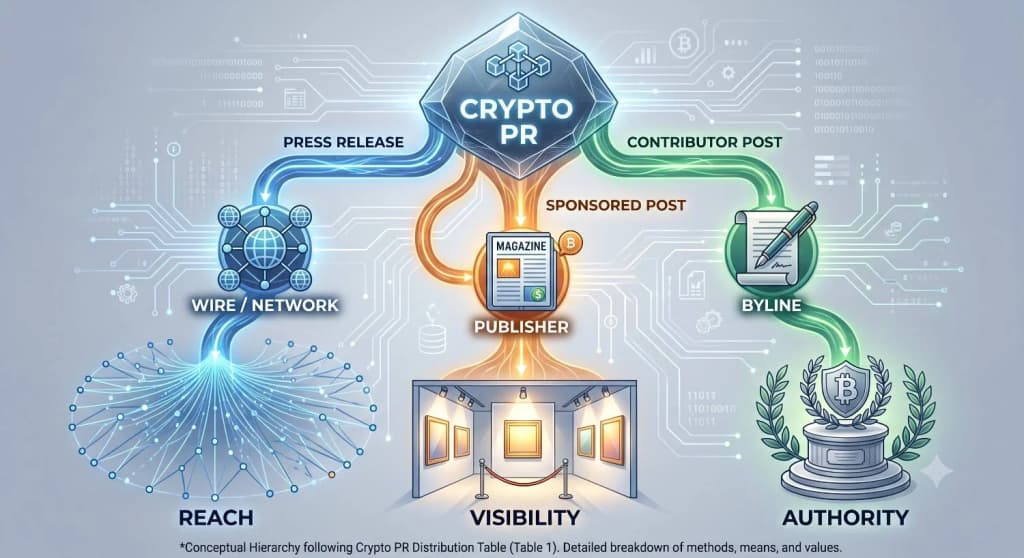
Crypto press release distribution is the process of getting a project's announcement — a token launch, a mainnet upgrade, a funding round, a partnership — published across news outlets that cover the crypto, blockchain and Web3 space. In practice, that covers three genuinely different products that the industry lumps under one label:
A press release, sent through a wire and syndicated to a network of outlets in a standard editorial format
A sponsored post, written to fit a specific publication's own voice and published natively on that publication's domain
A contributor post, a bylined piece published under the founder's or spokesperson's own name, positioning them as an industry voice rather than promoting a specific announcement
Most crypto teams find out these are different products only after paying for one and expecting the results of another.
Format | Main Purpose | Where Published | Typical Speed | Typical Value |
|---|---|---|---|---|
Press release | Announcement distribution | Wire syndication network | Fast | Reach and a documented distribution record |
Sponsored post | Publication-level exposure | Publisher's own domain | Medium | Brand visibility, native reader trust |
Contributor post | Thought leadership | Publisher's own domain, under a named byline | Slow | Founder authority and reputation |
A wire-distributed press release is fast and cheap, but it's usually a syndicated copy sitting on a partner site, not a native placement — its main value is breadth and a documented distribution trail, not deep authority on any single domain. (Distribution, publication, and search indexing are three separate stages, not one guaranteed sequence — more on that below.) A sponsored post costs more, takes longer, but lives permanently on the publication's own domain and often carries more reader trust because it reads like the outlet's own content. Whether it carries meaningful SEO value depends on the specific link's attributes and how Google's systems assess that page in context — not simply on whether the domain is high-authority. A contributor post is the slowest and hardest to place — most outlets vet the author, not just the content — but it builds something a press release can't: the founder's own name as a recognized voice in the space, which matters for future press pickups and investor due diligence. (For non-US founders, contributor coverage can also become part of a broader professional media record — though immigration eligibility is a separate question best evaluated with qualified counsel, not a press placement.)
None of the three is universally "better." They solve different problems, and the mismatch between what a project needs and what it buys is the single most common reason crypto PR spend feels wasted. This is the same "become the source, not just build the link" shift happening across digital PR generally — crypto is just the category where the stakes and the confusion are both highest.
Why do crypto press releases get rejected or held?
The first thing most crypto founders learn about press distribution is that writing quality doesn't determine whether a release gets published. A well-written, factually accurate release can still be rejected at a large share of the requested outlet list — not because an editor read it and passed, but because the outlet's editorial policy blocks the category outright, before anyone opens the file.
This is a legacy problem, not a current one. Years of pump-oriented press releases, fabricated trading-volume claims, and outright fraudulent token launches taught a lot of general-business and consumer-news outlets to blanket-ban the word "crypto" rather than review submissions case by case. The practical effect: a release about a legitimate DAO governance update or a gaming studio's Web3 integration gets auto-flagged the moment "token" or "NFT" appears in the category field, with nobody reading past the tag to notice the release has nothing to do with speculative trading.
This is why sub-category routing can matter particularly in crypto, where publishers may distinguish between token, infrastructure, NFT and Web3/gaming announcements. Token/DeFi announcements, blockchain infrastructure news, NFT releases, and Web3/gaming updates all draw different editorial reactions, even though they get bucketed together by outlets that don't distinguish them. A release that's routed only by the generic "crypto" tag, instead of its actual sub-category, ends up competing against — and getting rejected alongside — content it has nothing in common with.
Each of these four sub-categories has a genuinely different risk profile in an editor's eyes, which is worth understanding before choosing an outlet or format:
Token/DeFi — token launch, TGE (token generation event), ICO/IDO, liquidity, staking, yield, lending, TVL. Draws the most scrutiny, since it sits closest to securities and investment-product concerns — a new lending protocol or a token generation event gets read as a financial product first and a technology announcement second.
Blockchain infrastructure — Layer 1, Layer 2, validator, node, mainnet, testnet, protocol upgrade, interoperability. Reads more like traditional enterprise technology news and generally clears review faster, since there's no token sale or investment framing attached.
NFT — collectible, membership, gaming asset, digital ownership, marketplace, utility. Occupies a middle ground: a utility or membership NFT collection is closer in risk profile to infrastructure news, while anything framed around resale value or "floor price" potential gets treated like a token launch regardless of what the underlying asset actually is.
Web3/gaming — blockchain gaming, game studio, in-game assets, wallet, player ownership, Web3 integration. Can be easier to position when the announcement is primarily about gaming or technology rather than token speculation, since outlets and readers increasingly treat it as game industry news that happens to run on a blockchain, rather than crypto news that happens to be a game — provided the release doesn't lean on token-price framing to sell the announcement.
Knowing which of these four buckets a release actually falls into, and saying so explicitly rather than letting an outlet's intake form default to "crypto," is often the difference between a same-day approval and a release that sits in a queue for a week before being declined.
What makes a crypto announcement newsworthy?
Sub-category and format matter, but neither fixes an announcement that isn't news in the first place. Outlets and their editorial or sponsored-content teams both apply some version of a newsworthiness filter before anything else:
Generally strong hooks: a mainnet launch, a funding announcement, a major partnership, a product launch, a completed security audit, an acquisition, a protocol upgrade, a significant milestone (users, TVL, transaction volume) with a specific, sourced number attached.
Generally weak hooks: "we're excited to announce" framing with no actual news underneath it, a generic platform launch with no differentiation stated, vague AI-meets-blockchain claims, token price predictions, or promotional claims with no supporting evidence.
The connection matters semantically as much as practically: an announcement's newsworthiness is what determines editorial acceptance in the first place, before category, sub-type, or format ever come into play. A strong hook can sometimes clear review even in a hard sub-category; a weak one struggles even in an easy one.
Comparing crypto PR formats by news outlet
Here's where the format actually matters: not every outlet accepts all three, and the ones that do often price and position them very differently. This table also separates outlets by what kind of entity they actually are — a news publication, a data/discovery platform, and an exchange-linked social feed are three different things, even though they all get called "outlets" informally.
Outlet | Entity Type | DR | Organic Traffic | Placement Types | Best Fit |
|---|---|---|---|---|---|
Binance Square | Exchange social platform | 85 | ~68,100 | Sponsored/feed placement | Exchange-adjacent audience, high engagement for token-specific news |
Cointelegraph | Crypto publication | 82 | ~1,100 | Press release, sponsored post | Broad token/DeFi announcements, funding news |
CoinMarketCap | Crypto data/discovery platform | 82 | ~81,000 | Community post (native to a coin's own listing page) | Direct investor discovery — audience already viewing your token's data |
Financial publication | 80 | ~543,600 | Press release, sponsored post | Mainstream retail/institutional finance audience, major crossover credibility | |
Decrypt | Crypto publication | 76 | ~14,400 | Press release, sponsored post, contributor post | Retail/investor-facing news, deeper editorial credibility |
CryptoPotato | Crypto publication | 76 | ~3,700 | Press release, sponsored post | Retail token news, altcoin coverage |
Cryptopolitan | Crypto publication | 74 | ~6,600 | Press release, sponsored post | General crypto news, fast turnaround |
The Street | Financial publication | 72 | ~314,100 | Sponsored post (crypto vertical) | Mainstream financial audience, crossover credibility |
Manila Times | Regional publication | 71 | ~8,900 | Sponsored post, contributor post | Southeast Asian market entry, regional credibility for APAC-facing projects |
StreetInsider | Financial publication | 69 | ~31,500 | Press release, sponsored post | Institutional/trader audience, equity and crypto crossover coverage |
CoinGabbar | Crypto publication | 62 | ~4,200 | Press release, sponsored post | Emerging-market and India-focused crypto audience |
Treating a data platform, a social feed, and a news publication as equivalent "outlets" is one of the more common mistakes in how crypto PR gets planned — a CoinMarketCap community post and a Cointelegraph sponsored post solve different problems even though both show up on the same media list. TS Newswire's crypto and Web3 distribution track routes by these distinctions rather than treating "crypto" as one bucket.
A few things worth noting from this table that aren't obvious from domain authority alone. Domain rank measures backlink weight, but the keyword-ranking figures next to it tell a different story — Cointelegraph carries a very high DR (82) but ranks for comparatively few organic keywords (~1,100), since much of its authority comes from being widely linked to rather than from ranking broadly in search itself. Investing.com and The Street sit at the opposite end: both are mainstream financial portals ranking for enormous keyword sets (over 500,000 and 300,000 respectively), so a placement there reaches an audience well beyond crypto-native readers — useful for a project trying to establish credibility with a more traditional finance audience or ahead of an institutional conversation, but a different kind of reach than a crypto-specific outlet like CryptoPotato or CoinGabbar. High domain authority, high keyword count, and a high-intent audience are three separate things, and an outlet can score well on one without scoring well on the others.
CoinMarketCap's community post format is unlike anything else on this list — it doesn't function like traditional editorial placement at all; it appears directly on a token's own CMC listing page, reaching an audience that is, by definition, already looking at that specific asset. Combined with its own broad keyword footprint (~81,000 ranked keywords), that makes it one of the highest-intent placements available, even though CMC is a data platform, not a news outlet in the traditional sense. Binance Square works similarly — it's a feed-based placement inside Binance's own platform rather than a standalone published article, which changes both its distribution mechanics and its value: reach is tied to platform engagement rather than search indexing, even though its own domain authority and keyword footprint are both strong.
Manila Times and StreetInsider are worth calling out specifically because they serve narrower, more targeted purposes than the crypto-native outlets. Manila Times gives a project real regional credibility across the Philippines and wider Southeast Asian market — relevant for any project with APAC expansion plans or a Southeast Asia-based team. StreetInsider sits closer to an institutional and active-trader audience than a retail crypto readership, making it a useful complement to a press release aimed at investors rather than end users.
What gets a crypto release held, regardless of outlet
Independent of which outlet or format a release is going through, certain language patterns will get it held for revision almost everywhere, because the review is responding to real regulatory exposure, not house style.
"Guaranteed returns," "risk-free investment," and similar language are the fastest way to get a crypto release rejected by editorial review, and many outlets have their own explicit policies against publishing anything resembling an investment guarantee. That's an editorial-risk claim, and it's well documented across outlet guidelines. Separately, framing a token sale as an investment opportunity without disclosures is also frequently discussed in the context of securities-law exposure — that's a legal question, though, and one that varies by jurisdiction and specific facts; it's worth a compliance or legal review rather than treating this article as that review.
NFT releases run into a narrower version of the same problem. Describing an NFT collection as having guaranteed future value, or framing it primarily as a financial investment rather than a utility or collectible product, triggers the same editorial scrutiny — even when the underlying project is a legitimate gaming or membership NFT with no speculative framing intended.
The releases that clear review fastest, across every outlet in the table above, share the same characteristics: a named spokesperson with a verifiable role at the project or foundation, technical claims (TVL, mainnet status, audit results) that are sourced and current, and risk factors mentioned wherever the release touches on anything resembling an investment product.
On the SEO side specifically: wire-syndicated links are commonly tagged nofollow or sponsored, while a native sponsored post's link attributes depend on the specific agreement with that publisher and can vary placement to placement — there isn't one blanket rule per outlet, so it's worth confirming per placement rather than assuming.

Distribution, publication, and indexing aren't the same thing
A distribution report showing a release was "sent to" or "accepted by" 40 outlets can be functionally worth far less than one confirming 15 verified, indexed placements — and the two can look identical on a summary page unless the reporting distinguishes between the stages. It's worth separating them explicitly:
Sent → the release was submitted to the outlet or wire. Published → the outlet actually put it live on their site. Crawlable → the page is publicly accessible and not blocked from search engines. Indexed → a search engine has actually added the URL to its index. Search-visible → the page shows up in relevant search results, which is a further step even indexed pages don't automatically get.
One issue buyers should watch for, particularly in crypto PR: the incentive to show a large outlet count is real, since crypto marketing budgets are often tied to visible proof of coverage for investor decks or community updates. That creates pressure toward reporting that counts every stage above as equivalent, when they aren't. Before committing to a distribution partner, it's worth asking directly which of these stages their pickup report actually confirms — sent, published, or indexed — rather than assuming a placement count means the same thing across every provider. TS Newswire's own dashboard tracks confirmed publication and indexing status specifically because these stages get conflated so often.
Matching format to budget and goal
Given the three formats and the outlet landscape above, the practical question is which combination fits a given announcement and budget.
A straightforward token or protocol update with no unusual sensitivity — a feature release, a partnership, a routine milestone — is usually well served by standard wire distribution alone: fast, broad, and inexpensive, without needing the deeper investment of a native placement.
A major announcement meant to build lasting credibility — a mainnet launch, a significant funding round, a security audit result — benefits from pairing wire distribution with one or two sponsored posts on outlets like Cointelegraph or Decrypt, where the placement lives permanently on a established publication domain rather than disappearing into a syndication list.
A founder building long-term industry credibility — ahead of a funding round, a conference appearance, or (for non-US founders) an immigration filing that benefits from documented media recognition — is better served by investing in a contributor post, even though it's slower to place and doesn't announce a specific event. It builds the founder's name as a recognized voice rather than promoting a single news item, which compounds in value in a way a single press release doesn't.
Turnaround expectations differ across the three formats too, and budgeting for the wrong timeline is a common planning mistake. A standard wire release typically clears review and distributes within 12–24 hours once the category eligibility check and regulatory language review are complete. A sponsored post on a major outlet like Cointelegraph or Decrypt usually takes several days to two weeks, since it involves the publication's own commercial or partnerships team fitting the piece to their house style rather than simply syndicating a submitted release. A contributor post is the least predictable of the three — placement depends on an editor accepting the author as a legitimate voice first, which can take anywhere from a few weeks to a few months depending on the outlet's existing relationship with the founder or their PR representative. Projects planning around a specific launch date should treat the contributor-post track as a parallel, longer-term credibility investment rather than something timed to a single announcement.
Handling this end-to-end — the category eligibility check, the sub-type routing, the outlet relationship that gets a contributor through an unfamiliar publication's vetting process — is the actual work behind a distribution service, not just sending a file. TS Newswire's Crypto & Web3 track handles that routing and verification directly; current pricing tiers are here.
The bottom line
Crypto press release distribution fails most often not because of bad writing, but because of a mismatch between what a project needs and what it buys — a routine update paying contributor-post prices, or a credibility-building announcement going out as a bare wire release with no native placement anywhere. Understanding the three formats, knowing which outlets carry which type, and being honest about whether a pickup report reflects real, indexed placements rather than a padded send-count are the three things that separate crypto PR spend that compounds from crypto PR spend that disappears the day after it's sent.
FAQ
What's the difference between a crypto press release and a sponsored post?
A press release is distributed through a wire and syndicated across a network of outlets in a standard format — fast and broad, but usually not a native placement on any single high-authority domain. A sponsored post is written to fit a specific publication's voice and published directly on that outlet's own domain, which typically carries more reader trust; any SEO value depends on the specific link's attributes and context, not just the outlet's authority.
What is a contributor post and how is it different from a press release?
A contributor post is a bylined article published under a founder's or spokesperson's own name, positioning them as an industry voice rather than promoting a specific announcement. It's slower to place since most outlets vet the author, not just the content, but it builds durable personal credibility that a single press release doesn't.
Why do crypto press releases get rejected even when they're well-written?
A meaningful share of outlets have blanket policies against crypto content, a legacy of years of pump-oriented releases and fabricated claims that taught publications to reject the category outright rather than review submissions case by case. Rejection at these outlets usually has nothing to do with how well the release itself is written.
Can NFT and Web3/gaming releases go through the same channels as token announcements?
They can, but they perform better when routed to their own sub-category rather than a generic "crypto" bucket, since outlets and readers evaluate a utility NFT collection or a DAO governance update very differently from a speculative token launch.
What language gets a crypto release rejected regardless of the outlet?
"Guaranteed returns," "risk-free investment," and similar language are the most common cause of editorial rejection, and many outlets have explicit policies against publishing anything resembling an investment guarantee. Framing a token sale as an investment opportunity without proper disclosures is also frequently a legal/compliance question — worth a qualified review rather than relying on editorial standards alone.
How do I know if a crypto PR distribution report is accurate?
Ask specifically which stage the report confirms: sent, published, or actually indexed by search engines. These are three different things, and a placement count that doesn't distinguish between them can overstate real visibility.
Does a CoinMarketCap community post work like a normal press placement?
No — it appears directly on a token's own CMC listing page rather than as a standalone article, reaching an audience that is already looking at that specific asset. It's one of the highest-intent placements available precisely because of that context, even though CMC is a data platform, not a traditional news outlet.
Distribute your next announcement with named outlets
One-time pricing, compliance review for regulated industries, and a publication report with live links you can verify.