Let me tell you about one of the more painful calls I’ve had.
A crypto project — DeFi protocol, solid team, genuinely interesting product — had been building buzz for weeks. They had a major partnership announcement ready to go. They spent time on the release. They set an embargo with a handful of journalists to build anticipation. And then, two days before the embargo lifted, someone on their team posted about it in a public Telegram group.
By the time the official release went out, the story was already half-circulated in crypto media. The journalists who’d been briefed under embargo felt burned. Two of them pulled their coverage. The “big announcement” that was supposed to generate a wave of coordinated coverage landed with a fraction of the impact it should have had.
No bad actors. No sabotage. Just one person who didn’t fully understand what an embargo meant — and a team that hadn’t put clear internal controls around it.
That story sticks with me because the mistake had nothing to do with writing quality, distribution, or timing in the traditional sense. It was a process failure. And press releases fail in all kinds of ways that aren’t immediately obvious when you’re inside a launch.
After years of working through press releases across industries — SaaS, healthtech, iGaming, crypto, ecommerce — the failures I see most often aren’t mysterious. They’re consistent. They’re fixable. And they tend to cluster around the same seven mistakes.
Here’s what they are, why they happen, and what to do differently.
Key Takeaways
Most press releases fail for 3 reasons: wrong framing, wrong distribution, wrong timing
Press releases operate at 2 levels: syndication (SEO/backlinks) vs. earned editorial coverage
The 7 mistakes: no story hook, forgettable headline, wrong distribution, not newsworthy, bad timing, generic boilerplate, one-and-done send
Releases sent Tuesday–Thursday 8–11am earn 22–35% more journalist responses than Friday sends
Fixing the headline and distribution channel are the two highest-leverage changes
First: Two Very Different Things a Press Release Can Do
Before we get into the mistakes, let’s get clear on what success actually looks like — because a lot of disappointment comes from expecting one outcome while optimizing for another.
There are two levels a press release can work at.
Level 1 — Distribution and Syndication: Your release gets picked up by wire services and republished across a network of outlets. This builds your backlink profile, puts you on the SEO map, and creates a record of coverage you can point to. It does not, by itself, produce journalist-written stories.
Level 2 — Earned Editorial Coverage: A journalist reads your release, finds it genuinely compelling, and writes an original story about you. This is what most founders picture when they say they want “press.” It’s also what takes real work to earn.
A lot of press release disappointment comes from running a Level 1 strategy — bulk distribution, low-cost service, minimal targeting — while expecting Level 2 outcomes. The seven mistakes below affect both levels, but knowing which one you’re actually aiming for will help you read this more usefully.
Mistake #1: You Wrote an Announcement, Not a Story
This is the big one. Most press releases are written the way internal memos are written: company-first, feature-forward, excitement-loaded. “We are thrilled to announce the launch of our innovative new platform that helps businesses streamline their operations and achieve sustainable growth.”
Every journalist who covers your space has read a hundred versions of that sentence. It tells them nothing they need to know. It doesn’t tell them why this matters to their readers today. And that’s the only question that actually matters to them.
Journalists aren’t in the business of distributing your announcements. They’re in the business of telling their readers what’s happening in the world and why it matters. Your job is to make their job easy by answering that question up front.
The simplest reframe I know: stop leading with what you did and lead with what changed. Not “we launched X,” but “here’s what this means for anyone operating in this space.” Not “we’re excited to announce,” but “here’s the problem this solves and why now is the moment it matters.”
“The releases that actually get picked up don’t start with the company. They start with the news. There’s a meaningful difference between ‘we launched something’ and ‘here’s what just shifted in your industry.’ One is a memo. The other is a story.”
— Vivek Sharma, Founder & CEO, TS Newswire
Quick fix: Before you write the release, answer this one question in plain language: “Why would a journalist covering my beat want their readers to know about this today?” The answer to that question is your first paragraph. If you can’t answer it yet, you might not be ready to write the release.

Mistake #2: Your Headline Is Forgettable
The headline is doing the most important job in the whole release. Journalists, editors, and content aggregators make a sub-second decision based on it. If the headline doesn’t stop them, nothing else gets read.
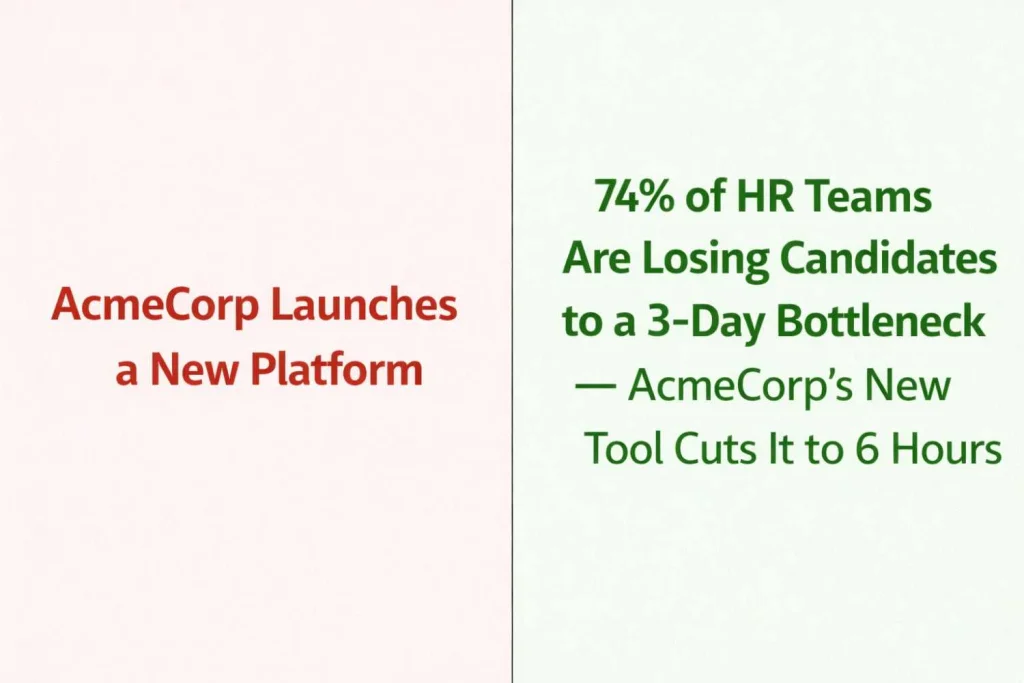
Most press release headlines fail in one of three ways: they’re vague (“AcmeCorp Launches New Platform”), they’re company-centric and jargon-heavy (“AcmeCorp Announces Strategic Alliance to Drive Synergistic Value”), or they bury the actual interesting thing in paragraph three.
Compare these two versions of the same announcement:
Weak: HR Tech Platform AcmeCorp Announces New AI-Powered Feature for Enterprise Recruitment |
Strong: New Research: 74% of HR Teams Are Losing Top Candidates to a 3-Day Hiring Bottleneck — AcmeCorp’s New Tool Cuts It to 6 Hours |
The second version has a data point, a specific problem, a specific outcome, and a reason to read further. The first is just a company telling you it launched something.
Quick fix: Write the headline last. By the time you’ve written the full release, you know what the most interesting element is — lead with that. If you have original data, put a number in the headline. If you have a surprising outcome, lead with the outcome. If a competitor published this exact headline, would you click it? If not, rewrite it.
Mistake #3: You’re Distributing to the Wrong Places (or Nowhere at All)
There are two opposite distribution mistakes, and both produce disappointing results.
The first is under-distribution: the release got emailed to a handful of journalists and called it a day. No wire service, no systematic outreach, no syndication. I talk to founders regularly who spent days writing a release and then “sent it out” by emailing eight people. That’s not distribution — that’s a long shot.
The second is bulk distribution without targeting: the release went through a cheap service that blasted it to 500 outlets indiscriminately. The result is a spreadsheet of “pickups” from sites nobody reads, with zero journalist engagement. According to a 2023 Cision study, around 73% of journalists receive more than 20 pitches per day — and the ones that land are almost always the ones that are precisely relevant to what they cover.
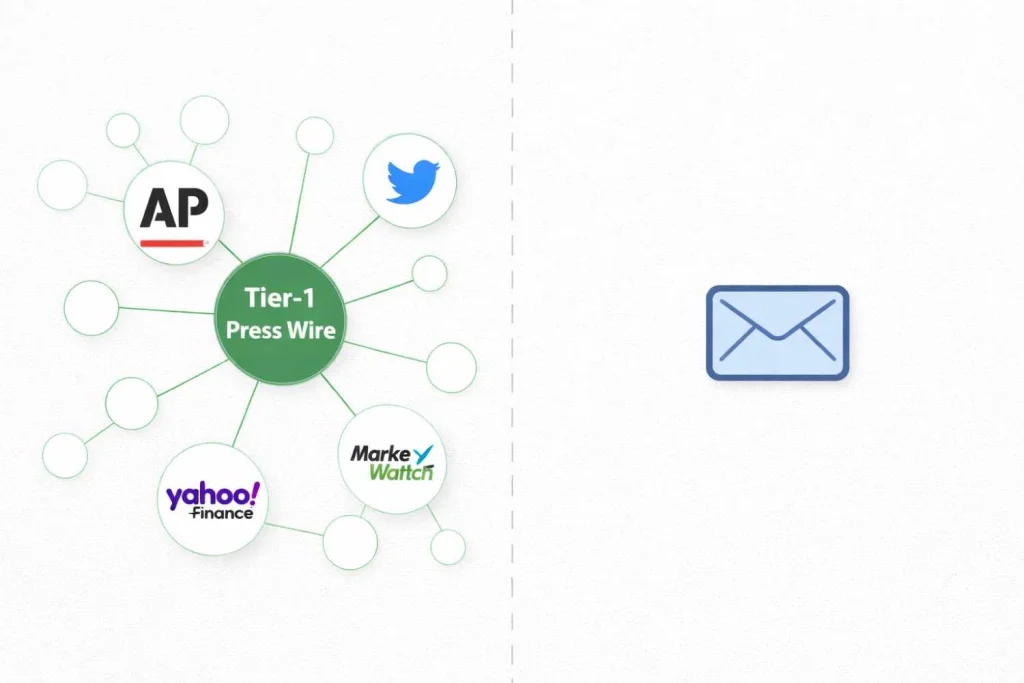
Getting both levels right means using a reputable wire service for Tier-1 and Tier-2 syndication (which builds your backlink profile and baseline coverage), combined with targeted journalist outreach — a short, personalized pitch to 15 to 30 reporters who genuinely cover your beat, not everyone on a megalist.
Quick fix: Two separate lists, two separate approaches. Wire distribution for reach and SEO value. Targeted journalist outreach for earned editorial coverage. If you want to understand how this fits into a broader link-building and digital PR strategy, our breakdown of guest posts, link insertions, and digital PR covers exactly how these tactics work together.
Mistake #4: The News Isn’t Actually News
This one’s uncomfortable to say, but it’s the honest answer behind a meaningful portion of press release failures: the announcement isn’t newsworthy enough for what you’re hoping to achieve.
Not everything is press-release-worthy. A minor feature update, a partnership that changes nothing for customers, an internal hire below C-suite level, an award from an industry group most journalists haven’t heard of — sending these through a wire service and expecting editorial pickup is setting yourself up for disappointment.
The announcements that consistently earn real coverage tend to be:
• Funding rounds (Series A and up get the most attention; pre-seed less so)
• Original research or data with findings that challenge what the industry assumes
• Product launches that genuinely create a new category or solve a problem in a new way
• Significant partnerships with recognizable brands or institutions
• C-suite hires with real name recognition in the space
• Regulatory approvals or milestone certifications in regulated industries
• Acquisition or exit news
Quick fix: Run your announcement through one honest filter: “Would a journalist who covers my industry write about this independently if they found out about it?” If the answer is no, consider whether a press release is actually the right vehicle. A thoughtful LinkedIn post, a well-distributed blog article, or a customer email might serve the same purpose without the expectation of media coverage you’re unlikely to earn.
Mistake #5: The Timing Is Off
Timing kills good press releases more reliably than bad writing does. And it’s usually one of three timing problems.
Wrong day: Releases sent on Fridays or Monday mornings consistently underperform. Friday means the news cycle is winding down and journalists are clearing their desks. Monday mornings are high-competition — everyone’s inbox is full. The consistent sweet spot is Tuesday through Thursday, 8am to 11am in your target journalists’ timezone. That’s when inboxes are active and editorial decisions get made.
Competing with the news cycle: A funding announcement sent the same week a major macro event is dominating coverage in your industry will get buried. Check what’s happening before you set your send date. This sounds obvious; most people skip it.
Sending after the fact: A press release about a product launch that’s already been live for two weeks isn’t news anymore. The release should go out at the moment of the announcement, not after it’s already circulated organically. And if you’re using an embargo — as that crypto team learned the hard way — make sure everyone with access to the information understands clearly what the embargo means and how it works. One public post in the wrong channel undoes weeks of careful journalist relationship-building.
Quick fix: Treat your send date with the same care as the release itself. Mid-week, morning send, no competing news events. And if you’re running an embargo, brief your internal team explicitly — in writing — on what they can and cannot say before the release date.
Mistake #6: The Boilerplate Is Generic and Forgettable
The boilerplate — the “About Us” paragraph at the bottom — is probably the most undervalued real estate in the whole release. Most companies write it once, copy-paste it forever, and never think about it again.
A bad boilerplate says something like: “XYZ is a leading provider of innovative solutions helping businesses achieve their goals.” That sentence says nothing. Every word is a placeholder. It signals to journalists, analysts, and anyone who reads it that the company either doesn’t know what it does well or doesn’t care enough to say it plainly.
Here’s the thing: the boilerplate is a credibility check. Journalists on the fence about a story read it. Investors who see your coverage read it. Analysts who track your space read it. A vague boilerplate quietly undermines the credibility of everything above it.
Quick fix: Rewrite your boilerplate as if it’s the one paragraph someone will read to decide whether your company is worth taking seriously. Be specific: what do you actually do, for whom, and what’s one concrete scale or outcome indicator that proves it? Update it whenever your numbers or milestones change. A strong boilerplate reads like a confident two-sentence pitch, not a legal disclaimer.
Mistake #7: You Sent It Once and Moved On
Press releases are not self-distributing. Sending through a wire service is the beginning of the process, not the end of it. The brands that consistently generate editorial coverage treat the release as an anchor for a multi-channel push — not a one-shot send.
What that push looks like in practice:
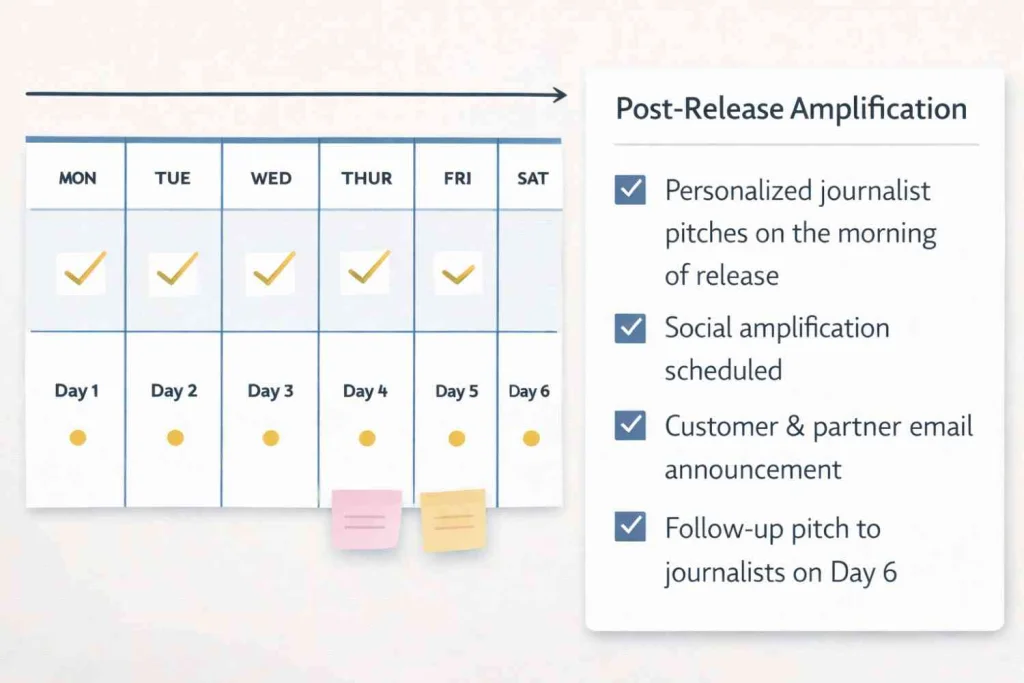
• A personalized journalist pitch goes out the same morning as the release. Not the same template to everyone — a short, specific note tied to each reporter’s beat and audience
• A LinkedIn post from the founder or executive quoted in the release, with a native angle (not just “we published a press release”)
• An email to your existing customer and partner list — these people are primed to share, and their engagement signals matter
• A follow-up to journalists who opened the pitch but didn’t respond — one follow-up, five to seven days later, is appropriate and frequently moves things forward
• The key data or insight repurposed as a short-form social asset, quote card, or standalone article
Quick fix: Build a post-send checklist before you distribute. Identify three to five journalists who are most likely to care about this specific story, and have their personalized pitches ready to send the same morning. Schedule your social amplification in advance. Set a follow-up reminder for day six. The release is a content asset — treat the distribution like one.
The Pattern I Keep Seeing
If I’m being direct: the founders who come to me most frustrated aren’t usually the ones with weak stories. They’re often the ones with genuinely newsworthy announcements who failed on execution. Real funding. Real product launches. Real data. The story was there. The execution wasn’t.
They buried the lede in paragraph three. They used a low-cost bulk distribution service that placed their release on 400 sites nobody reads. They sent on a Friday afternoon. They never followed up. And in the crypto case I mentioned at the top — they didn’t control the information before the embargo lifted.
“The story was there. The execution wasn’t. That’s actually the most common and the most fixable version of this problem. Good news, written poorly and distributed carelessly, gets the same result as no news at all.”
— Vivek Sharma, TS Newswire
One more thing worth naming: the bar on distribution quality has genuinely shifted in the last two years. Google’s increased scrutiny of site reputation has reduced the SEO value of bulk low-quality syndications. A release that lands on 400 thin sites is worth meaningfully less than one that lands on 40 real outlets with editorial standards and real traffic. The service you use to distribute matters more now than it did three years ago.
The 14-Point Press Release Checklist
Before you hit send on your next release, run through these. If you can’t honestly tick every box, keep editing.
Story & Newsworthiness
✓ I can answer “why does this matter to a journalist’s audience” in one clear sentence
✓ This announcement is genuinely newsworthy — not just important internally
✓ The release leads with the news, not with the company
Headline & Structure
✓ The headline contains a specific data point, outcome, or surprising element
✓ The most important information is in the first two paragraphs
✓ There is a named, quoted spokesperson with a relevant credential
✓ The boilerplate is specific, current, and credibility-building
Distribution
✓ I’m using a reputable wire service with genuine Tier-1 and Tier-2 reach
✓ I have a targeted journalist list of 15–30 reporters who specifically cover this beat
✓ My send time is Tuesday–Thursday, 8–11am in my target journalists’ timezone
✓ I’ve checked the news calendar for conflicting events on my send date
Amplification
✓ Personalized journalist pitches are ready to send the morning of distribution
✓ Social amplification content is prepared and scheduled
✓ A follow-up sequence is planned for non-responders at day 5–7
If You’ve Hit These Walls Before
Most of the mistakes above are fixable before you distribute — they’re writing and strategy problems, not resources problems. The distribution and amplification failures are where working with the right partner makes a real difference.
At TS Newswire, our press release distribution puts your announcement in front of journalists and editorial outlets across Tier-1 and Tier-2 publications with real editorial standards and real traffic — not just volume metrics. If you’ve distributed before and seen weak results, we’re happy to take a look at what you sent and give you a straight answer on what we’d change.
And if you want to understand how press releases fit into a broader SEO and authority-building strategy — alongside guest posts, link insertions, and digital PR — we wrote the full breakdown here: Guest Post vs Link Insertion vs Digital PR: What Each One Does for Your SEO. It’s worth reading before you build your next campaign.
Frequently Asked Questions
Why do most press releases fail to get media coverage?
Most press releases fail for three interconnected reasons: the announcement is written as a company memo rather than a news story with a clear hook for the journalist’s audience; the distribution doesn’t reach the right journalists at the right outlets; or the timing is poor. Fixing the story framing and distribution quality are the two highest-leverage changes most brands can make. The other mistakes in this article — weak headlines, forgettable boilerplate, sending once and moving on — compound those core problems.
What makes a press release newsworthy?
A newsworthy press release has a genuine development that affects an industry or audience beyond the company itself, a specific and data-backed or surprising element, a named spokesperson with real credentials, and a clear ‘so what’ for the journalist’s readers. Funding rounds, original research with meaningful findings, significant product launches, and notable partnerships consistently meet the newsworthiness bar. Feature updates, junior hires, and generic milestone announcements typically don’t.
How long should a press release be?
400 to 600 words is the sweet spot for most press releases. Journalists have limited time and prefer concise, scannable releases. Structure it as: headline and subheadline, dateline and lede paragraph (most important information first), body paragraphs with supporting details and a quote from a named spokesperson, a specific boilerplate, and media contact information. Everything that doesn’t serve the story should be cut.
Is press release distribution still worth it for SEO in 2026?
Yes, but the value has shifted toward quality over volume. Bulk distribution to hundreds of low-quality sites provides diminishing returns as Google’s site quality evaluation has improved. Distribution through quality wire services that place your release on genuine Tier-1 and Tier-2 publications with real traffic generates credible backlinks, branded search impressions, and indexable content that supports your authority profile. The distribution service you use matters significantly more than it did three years ago.
What is the best day and time to send a press release?
Tuesday through Thursday, between 8am and 11am in the target journalist’s timezone, consistently outperforms other send windows. Monday mornings are high-competition — journalists are clearing a backlog. Fridays mean low engagement. Avoid sending the day before or after major holidays, or during weeks dominated by large news events in your industry.
What happens if an embargoed press release leaks early?
An early leak typically destroys the coordinated editorial coverage the embargo was designed to create. Journalists briefed under embargo may pull their planned stories if the news circulates publicly before the agreed date — they feel burned, and it damages the trust relationship. To prevent this: brief everyone with access to the announcement explicitly, in writing, on what the embargo means. Restrict access to the release and the announcement details to only those who need it before the send date. One public post in the wrong channel can undo weeks of careful journalist relationship-building.
How do I know if my press release distribution worked?
Measure at two levels. Level 1 (distribution quality): how many Tier-1 and Tier-2 publications with real editorial standards picked up the release, what the domain authority of those outlets is, and what the quality of backlinks generated looks like. Level 2 (editorial outcome): direct journalist inquiries generated, original stories published about the announcement, and secondary coverage that cited the original release. Total pickup count that includes low-authority sites is a vanity metric — focus on quality-adjusted reach.

 Vivek Sharma
17 min read
399 views
Vivek Sharma
17 min read
399 views