A client I worked with earlier this year — an in-house SEO lead at a mid-sized SaaS company — sent me a message that's probably familiar to anyone running a link-building program:
"We're doing guest posts, our agency is doing link insertions, and our PR firm keeps pitching us 'digital PR.' I honestly don't know if these are three versions of the same thing or three completely different tactics. Can you just help me understand what I'm actually buying?"
It's a fair question, and the confusion is understandable. At a surface level, all three produce backlinks. All three involve getting your website mentioned on someone else's website. All three are frequently pitched as "SEO link building."
But if you've been running any of them for more than a few months, you've probably noticed they produce very different results — in terms of link quality, ranking impact, brand visibility, and how Google seems to treat them over time.
This article is the breakdown that client needed. We're going to go through each tactic honestly — what it actually is, how it works mechanically, what it does for your SEO, what it costs in time and money, and when you should be using it. No vendor spin. No oversimplification. Just a clear framework so you can build a link strategy that makes sense for your goals.
First, a Ground Rule: These Are Not Substitutes for Each Other
Before we dive in, I want to push back on the framing many agencies use, which is something like: "Pick the one that fits your budget."
That's not quite right. Guest posts, link insertions, and digital PR aren't interchangeable options on a menu. They operate at different speeds, at different costs, for different strategic purposes. A mature off-page SEO program typically uses all three — at different stages of growth and for different goals.
The question isn't "which one should I do?" It's "what am I trying to accomplish, and which tactic serves that goal at this stage?"
With that established — let's go through each one.

Part 1: Guest Posts
What It Actually Is
A guest post — sometimes called a contributor article or bylined piece — is original content that you (or your team) write and publish on someone else's website. In exchange for providing valuable content to their audience, you typically receive one or more do-follow backlinks in the body of the article or in your author bio.
The fundamental transaction is: your content and expertise, in exchange for their audience reach and domain authority.
In theory, this is a win for everyone. The host site gets free, expert content. You get a link and a platform to demonstrate authority. The reader gets genuinely useful information.
In practice, it's more complicated — and how you run a guest posting program determines whether it delivers real SEO value or fades into background noise.
How Guest Posting Works (Mechanically)
The basic process looks like this:
Prospecting — You identify websites in your niche that accept guest contributions. You're looking for sites with relevant topical authority, real human readership, and editorial standards that mean placement there signals something.
Outreach — You pitch the editor or site owner with a topic idea. Strong pitches connect your expertise to a gap in their existing content. Weak pitches read like "I'd like to write something for SEO purposes." Editors can tell the difference.
Writing — You produce original, useful content built for that site's audience. The internal link to your target page appears naturally within the piece — not stuffed in.
Publication and indexing — The post goes live, gets indexed, and the link begins passing authority to your domain.
The full cycle, from outreach to published post, can take anywhere from two weeks to three months depending on the site's editorial timeline and how many pitches they're processing.
What Guest Posts Do for Your SEO
Guest posts primarily build topical authority and domain authority simultaneously.
When you publish a well-structured article on a relevant industry site, Google sees several things at once: a credible, thematically consistent backlink from a domain that covers your topic space; a named author with expertise in that domain (an increasingly important EEAT signal); and content that demonstrates your brand's knowledge depth, reinforcing what Google understands about your topical relevance.
Over time, a consistent guest posting program in your niche builds a web of thematic links that tells search engines: this brand is a legitimate authority in this space. That's different from just accumulating high-DA links. Topical consistency matters — a collection of links from genuinely relevant industry sites will outperform an equal number of links from high-DA sites in unrelated verticals.
Guest posts also have a secondary benefit that's underrated: they put your brand in front of real audiences. Unlike a link insertion buried in a two-year-old article, a guest post is current, promoted by the host site, and likely to generate referral traffic and brand awareness alongside the SEO benefit.
What Guest Posts Don't Do Well
Guest posting is not particularly efficient for rapid link velocity. If you're trying to close a competitive keyword gap quickly, the two-to-twelve-week production cycle for each post is a real constraint.
It also doesn't scale cheaply. A guest post on a high-authority, editorially rigorous site — one where the link actually carries weight — requires real content investment. Budget solutions (low-quality posts on low-quality sites) carry significant risk in the current environment. Google's Helpful Content updates and site reputation abuse enforcement have reduced the value of thin placements and, in some cases, made them actively harmful.
What it costs: Expect $200–$800+ per placement for genuine editorial quality sites, depending on domain authority, niche, and content production involved. Placements on premium industry publications can run $1,500+. Anything significantly cheaper than this range should raise questions about the editorial standards of the host site.
When to Use Guest Posts
Guest posting is the right tool when you're building topical authority in a specific niche over a 6–18 month horizon, when you want link building that also drives brand awareness and thought leadership, when your content team can produce genuine publication-quality writing, and when you're playing the long game in a competitive vertical where Google rewards established authority.
Part 2: Link Insertions (Niche Edits)
What It Actually Is
A link insertion — also called a niche edit — is exactly what it sounds like: you pay a site owner to insert a hyperlink pointing to your website into an article that already exists on their site.
You're not writing new content. You're purchasing placement within existing content. The host site adds a sentence or modifies an existing one to include a link to your target page, and the article continues as before.
The appeal is obvious: you skip the content production cycle entirely and land a link in a piece that's already indexed, already ranking in many cases, and already accumulating trust signals.
How Link Insertions Work (Mechanically)
The process is faster and operationally simpler than guest posting. You find published articles on relevant sites that cover topics adjacent to your target page. You contact the publisher or use a broker service and propose the edit, typically suggesting where the link fits naturally within the existing copy. A fee is agreed upon, the publisher edits the post, and you verify the link is live, do-follow, and pointing to the correct target.
The whole cycle can complete in a week or two — far faster than a guest post workflow.
What Link Insertions Do for Your SEO
Link insertions are primarily a tool for link velocity and domain diversity — building your backlink profile faster and across a broader range of referring domains than guest posting alone can deliver.
They're particularly effective for closing a domain diversity gap (if you're competing where competitors have 200+ unique referring domains and you have 80, link insertions compress that gap quickly), for targeting specific anchor text (you have more control over anchor text and topical context than with a guest post bio link), and for capturing the authority of existing pages (a link in a two-year-old article that already ranks for related keywords passes different signals than a brand-new guest post with zero history).
What Link Insertions Don't Do Well
Here's where I want to be direct about something the industry doesn't say often enough: link insertions are the tactic most exposed to Google policy risk if done at scale with poor site selection.
The reason is structural. An edited sentence dropped into an otherwise unrelated article, with an anchor text that matches exactly what someone's trying to rank for, looks like what it is — a paid link — when Google's systems are trained to identify it. The signal isn't organic. There's no reader benefit. The edit typically doesn't add editorial value to the host page.
This doesn't mean link insertions are off the table. It means site selection and editorial quality control are non-negotiable. A link insertion into a genuinely relevant, editorially maintained article on a quality site is a legitimate tactic. A link insertion into a low-traffic, low-quality site that exists primarily to sell placements is a liability.
The other limitation is brand building. Link insertions don't put your brand voice in front of an audience. They don't create content that can be cited, amplified, or shared. They're purely a backlink transaction — which is fine as a component of a strategy, but not as a strategy in itself.
What it costs: Quality link insertions typically run $100–$500 per link, depending on domain authority and niche. As with guest posts, significantly lower prices usually signal lower quality or higher risk.
When to Use Link Insertions
Link insertions make sense when you need to close a link volume or domain diversity gap faster than guest posts allow, when you've identified specific pages that need additional link equity to compete for commercial keywords, when you have rigorous site selection criteria and are not working with link farms or low-quality directories, and when you're using them to complement guest posts and digital PR — not as a sole tactic.

Part 3: Digital PR
What It Actually Is
Digital PR is the practice of earning media coverage — real editorial mentions and backlinks — from journalists and publications through newsworthy stories, original data, expert commentary, and strategic outreach.
The critical word is earned. You don't pay for the placement. You earn it by giving journalists something genuinely worth publishing: a compelling finding from original research, a timely expert perspective on breaking news, a story tied to a trend their readers care about.
The link and the mention are byproducts of editorial coverage — not the product being purchased.
This is the fundamental distinction between digital PR and the other two tactics. Guest posts and link insertions are negotiated transactions. Digital PR is an editorial outcome. And that difference matters enormously for how Google treats the resulting links.
How Digital PR Works (Mechanically)
Digital PR typically takes a few different forms. Original research and data studies — you commission or compile original data and publish findings that journalists in your space would want to cover. A fintech company publishes an annual study on consumer credit behavior. A SaaS HR platform publishes benchmark data on remote work productivity. The story spreads, and links accumulate from outlets that cover the finding.
Expert commentary and reactive PR — you position a named spokesperson as a credible voice on topics in your industry, and pitch them to journalists covering breaking developments. When a journalist at a major publication needs a quote from an AI expert and you've got one — that's a link, a mention, and a brand impression at a publication you couldn't have bought into.
Press release distribution — a structured announcement of a genuine newsworthy event (funding, launch, partnership, milestone) distributed through quality wire services and followed up with targeted journalist outreach. Done well, this creates a cluster of coverage across multiple publications, each carrying a link and a signal that your brand is worth covering.
Linkable asset campaigns — you create genuinely useful resources (interactive tools, definitive guides, original indexes) and pitch them to publications and blogs as reference material for their own coverage.
Newsletter
Stay in the Loop
Strategic insights on PR & digital communications, delivered weekly.
What Digital PR Does for Your SEO (and Brand)
Digital PR does things the other two tactics structurally cannot.
It generates links Google trusts the most. An editorial link in a tier-one publication isn't purchased and isn't negotiated. A journalist chose to include it because the content warranted it. These links carry disproportionate authority weight precisely because they're hard to manufacture. Google's systems are reasonably good at distinguishing between links that reflect editorial judgment and links that reflect commercial arrangements.
It builds real brand authority. When your CEO is quoted in TechCrunch, when your research is cited in a roundup, when your press release lands in AP News — that's not just a backlink. It's a brand impression at scale. Customers, investors, journalists, and potential hires see it.
It compounds over time. Coverage generates secondary coverage. A data study gets covered by one outlet, then picked up by three others who cite the first. A quote in a major publication establishes your spokesperson's credibility, making future pitches easier to land.
It feeds AI citation. With generative search engines now citing specific sources in their answers, earned media placements in authoritative publications put your brand in the pool of content that AI systems draw from. A link insertion in a third-tier blog does not. The structure and credibility of editorial coverage is exactly what AI systems look for when deciding what to cite — which matters more with every passing quarter as AI search grows in share.
What Digital PR Doesn't Do Well
Digital PR doesn't give you control or predictability the way paid link tactics do. You can craft the best pitch in the world and still have a journalist decline because the news cycle moved, their editor killed the story, or they got to your email three weeks after it was relevant.
It also has a longer and less certain timeline. A link insertion campaign can produce 20 links in a month. A digital PR campaign requires story development, outreach, editorial turnaround, and publication timelines that may stretch over weeks. If you need to boost domain diversity fast, digital PR alone isn't your tool.
And it has a higher story bar. You cannot do digital PR without something genuinely newsworthy — a funding announcement, a real product milestone, original research, a strong take on a breaking story. If you don't have the news, you don't have the tactic.
What it costs: Digital PR through an agency typically runs $2,000–$10,000+ per campaign, depending on the scale of outreach, the level of research involved, and the tier of outlets targeted. A targeted press release campaign with editorial distribution and journalist follow-up typically starts at $500–$2,000 for quality execution.
When to Use Digital PR
Digital PR is the right tool when you have genuine news or original data worth publishing, when you're trying to build links that will remain valuable regardless of Google algorithm changes, when you want link building that simultaneously builds brand authority, when you're in a competitive vertical where the highest-authority links are editorially earned, and when you're building toward AI search visibility and want your brand cited in AI-generated answers.
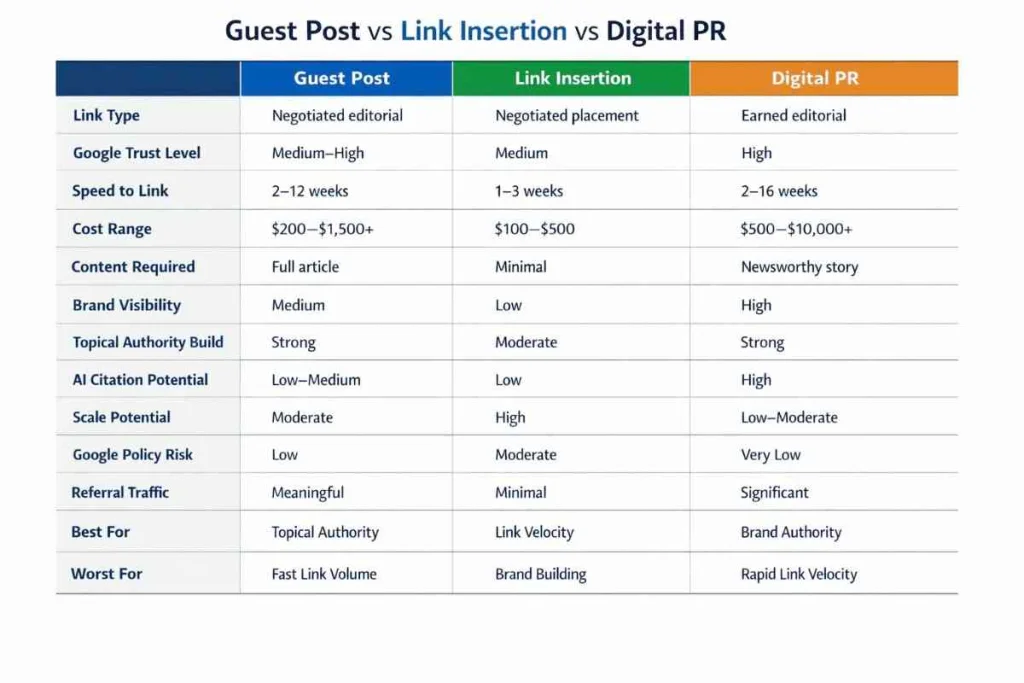
Side-by-Side Comparison: Guest Post vs Link Insertion vs Digital PR
Factor | Guest Post | Link Insertion | Digital PR |
|---|
Link type | Negotiated editorial | Negotiated placement | Earned editorial |
Google trust level | Medium–High (quality-dependent) | Medium (site/context dependent) | High (genuinely earned) |
Speed to link | 2–12 weeks | 1–3 weeks | 2–16 weeks (less predictable) |
Cost range | $200–$1,500+ per post | $100–$500 per link | $500–$10,000+ per campaign |
Content required | Yes — full article | Minimal | Yes — newsworthy story |
Brand visibility | Medium (bylined exposure) | Low (buried link) | High (editorial coverage) |
Topical authority build | Strong | Moderate | Strong (if consistent) |
AI citation potential | Low–Medium | Low | High |
Scale potential | Moderate | High | Low–Moderate |
Google policy risk | Low (at quality sites) | Moderate (at scale) | Very low |
Referral traffic | Yes, meaningful | Minimal | Yes, significant |
Best for | Topical authority, thought leadership | Link velocity, domain diversity | Brand authority, AI visibility, premium links |
Worst for | Fast link volume | Brand building | Rapid link velocity |
How These Three Tactics Work Together
The most effective link-building programs don't pick one lane. They use all three tactics strategically — each doing what it's best at, at the right stage of growth.
Early stage (months 1–6): Focus is on building foundational link volume. Link insertions provide domain diversity fast. Targeted guest posts in the core niche begin establishing topical authority. Digital PR is used when genuine news exists — a launch, a funding round, a founding story. Budget split: roughly 50% link insertions, 35% guest posts, 15% digital PR.
Growth stage (months 6–18): Guest posting becomes more selective — fewer posts, higher domain authority targets, stronger topical alignment. Digital PR scales up as original data campaigns become possible. Link insertions are used tactically for specific page-level gaps, not as the primary volume driver. Budget split: roughly 40% guest posts, 35% digital PR, 25% link insertions.
Authority stage (18+ months): Digital PR carries more of the link-building weight because the brand has enough credibility that journalists respond to it. Guest posts become thought leadership placements on tier-one industry publications. Link insertions are reserved for specific competitive keyword situations. Budget split: roughly 50% digital PR, 30% guest posts, 20% link insertions.
These are starting points, not fixed rules. Your competitive landscape, keyword targets, content capabilities, and brand equity all factor in.
A Note on Google's Direction
One thing worth stating plainly: Google's algorithmic and policy trajectory over the past three years has consistently moved in the same direction — away from links that are clearly purchased and toward links that reflect genuine editorial judgment.
The Site Reputation Abuse policy (March 2024) targeted sites hosting third-party content purely for SEO value. The Helpful Content updates targeted thin, formula-driven content that existed to pass authority rather than inform readers. The expansion of EEAT evaluation rewarded real authors, real expertise, and real sourcing. If you want to go deeper on how this has changed the broader media landscape, our piece on press release distribution in 2026 covers the Google policy evolution in detail.
This trend doesn't make guest posts or link insertions obsolete — but it does make quality and selectivity non-negotiable. The low end of both markets (thin guest posts on PBNs, link insertions in irrelevant low-traffic sites) has become genuinely risky. The high end — real editorial relationships, real content, real placements — has become more valuable as the noise floor has dropped.
Digital PR, by virtue of being earned rather than bought, is the most durable of the three over any time horizon. Which doesn't mean you should only do digital PR — but it does mean it should have more weight in your program than it does in most agency budgets.
The Honest Guide to Choosing the Right Mix
If you're an SEO manager trying to allocate budget across these tactics, here's a practical framework:
If your domain authority is below 30 and you're in a competitive niche: Lead with link insertions for fast domain diversity and guest posts for topical authority. Use digital PR whenever you have a real news hook. Approximate split: 50% link insertions, 35% guest posts, 15% digital PR.
If your domain authority is between 30–50: Shift toward guest posts for topical depth. Scale up digital PR — you now have enough brand credibility to pitch mid-tier industry publications. Use link insertions tactically for specific page-level needs. Approximate split: 40% guest posts, 35% digital PR, 25% link insertions.
If your domain authority is above 50 and you're playing a long-term authority game: Digital PR should be the primary driver. Your brand is credible enough to earn tier-one editorial coverage. Guest posts become premium thought leadership placements. Link insertions are surgical interventions, not volume plays. Approximate split: 50% digital PR, 30% guest posts, 20% link insertions.

How TS Newswire Approaches This
We've been running press release distribution and digital PR campaigns since 2020, across 30,000+ placements for clients ranging from SaaS startups to iGaming operators to healthtech brands.
What that volume has taught us is pretty consistent with everything above: the clients who see durable ranking improvement are the ones treating link building, guest posting, and digital PR as a coordinated program — not chasing link volume as an end in itself.
The best results come when guest posts are placed on sites with real editorial standards and real audiences; link insertions are reserved for specific competitive gaps; and digital PR is anchored to genuine news — original research, real milestones, credible spokesperson commentary.
If you're running a program that's heavy on link insertions and light on earned media, it's worth examining whether the link profile you're building is durable. Not because link insertions don't work — they do — but because the ones that compound into real authority gains are the ones that hold up as Google's quality signals continue to improve.
Curious which approach makes sense for your stage and goals? Talk to our team — we'll give you a straight answer.
Frequently Asked Questions
What's the difference between a guest post and a link insertion?
A guest post involves creating and publishing a new piece of original content on a host website, with a link included in the body or author bio. A link insertion adds a hyperlink into an existing published article on a host site, without creating new content. Guest posts offer brand visibility and content marketing value alongside the link. Link insertions are faster and require no content production, but provide less editorial context and no audience-facing exposure.
Are link insertions (niche edits) safe for SEO?
It depends almost entirely on the quality of the host site and the editorial context of the placement. A link insertion into a genuinely relevant, well-maintained article on a credible site is a legitimate SEO tactic. A link insertion into a thin, low-traffic site that exists primarily to sell placements carries real risk — particularly as Google has become more sophisticated at identifying paid link patterns. The tactic is safe when site selection is rigorous and it's used as part of a diversified link strategy.
Does digital PR actually help with SEO rankings, or is it just brand awareness?
Both. The links generated through editorial coverage — in publications like Forbes, AP News, TechCrunch, or industry-specific outlets — carry disproportionate authority weight because they reflect genuine editorial judgment. For competitive commercial keywords, a handful of genuinely earned editorial links can outperform dozens of negotiated placements. The brand awareness value is real too, but the SEO mechanics of high-authority earned links are very well established.
How many guest posts do I need per month to see results?
There's no universal number — it depends on your current backlink profile, competitive landscape, and the authority level of sites you're targeting. As a rough benchmark, a consistent program of 4–8 quality guest posts per month on genuinely relevant, editorially selective sites produces measurable authority gains over a 6–12 month period. Two high-authority, topically relevant guest posts outperform ten low-quality placements on thin sites, both in SEO value and risk profile.
Can I use all three tactics at the same time?
Not only can you — you probably should if you're running a serious link-building program. They serve complementary functions: digital PR earns your highest-trust links and builds brand authority; guest posts build topical relevance and thought leadership; link insertions close domain diversity gaps quickly. A program using only one tactic will hit limits that a coordinated approach avoids. The key is having clear goals for each tactic rather than using them interchangeably.
What's the biggest mistake brands make with guest posting?
Prioritizing volume over quality. The instinct to publish as many posts as possible — especially when using lower-cost services — leads brands toward sites that exist to sell placements rather than serve real audiences. These placements produce links, but not links that carry meaningful authority signals. A guest post on a genuinely relevant site with real traffic and editorial standards will outperform ten posts on low-quality sites in both SEO impact and risk profile. Publish fewer posts on better sites.
How do I know if a site is worth getting a guest post or link insertion on?
Look beyond domain rating (DR) or domain authority (DA) as the sole criterion — these metrics can be gamed. Instead evaluate: Does the site have real, organic traffic? Does it cover topics genuinely relevant to your niche? Does it have real editorial standards — does it turn down submissions? Are existing backlinks from credible sources? Is the content written for human readers or primarily to pass SEO signals? A site that passes those questions is worth placing on. One that doesn't, isn't.
What kind of content works best for digital PR?
Original data and research performs best, consistently. Studies, surveys, proprietary benchmark reports — these give journalists something to cite that they can't find elsewhere, which is exactly the editorial currency that earns genuine coverage. Expert commentary on breaking news is the fastest to execute: positioning a credible spokesperson to respond to a major industry development can generate media mentions within 24–48 hours. Story-driven press releases anchored to real milestones also generate consistent coverage when distributed through quality channels.
Is digital PR worth it for small or early-stage companies?
Yes, but the approach differs. Early-stage companies typically can't land coverage in tier-one publications on brand strength alone. What works is founding story angles, original research (even small-scale surveys can generate coverage), and reactive commentary — positioning the founder as an expert voice on trends in their space. A few well-placed, genuinely earned mentions in mid-tier industry publications build more long-term SEO and brand equity than a large volume of negotiated link insertions.

 Vivek Sharma
21 min read
516 views
Vivek Sharma
21 min read
516 views