

Quick answer
Fix your Google Business Profile, reviews, and service pages before you touch content — nothing you publish compensates for a thin local presence.
Build one useful, public guide instead of a blog full of generic tips. Split it into an open pillar page plus a narrower, gated checklist as your actual lead magnet.
Every page needs a next step — a quote request, a call button — not just a newsletter signup.
Press releases, guest posts, and expert mentions matter, but only after the fundamentals are in place. They amplify credibility; they don't create it.
AI-powered search tools tend to favor clear, well-structured content backed up elsewhere on the web — a pattern worth building around, not a guarantee.
If you're trying to get more cleaning clients in 2026, more blog posts isn't the answer. The cleaning companies actually getting more calls and bookings aren't the ones cranking out the most content — they're the ones who fix the basics, publish one genuinely useful guide, and give every visitor a clear next step toward booking a job. Content isn't the product. It's what gets someone from a search bar to your phone.
The problem with most cleaning company websites
Go look at ten cleaning company websites right now. You'll mostly find one of two things: nothing useful at all, or a blog full of "10 cleaning tips" posts that don't lead anywhere. Neither gets you customers. The first is invisible. The second gets a trickle of traffic that reads the post, gets its answer, and leaves — no reason to ever pick up the phone.
More content isn't the fix. The fix is content built to do one job: answer a real question, then give the reader a reason to become a lead. Before any of that works, though, there's a foundation that has to be in place — which is where most of this actually starts.
How customers actually search before hiring a cleaning company
Not every question a homeowner asks deserves the same kind of content, and mapping this out changes what you should actually build:
What they're trying to do | Example search | What to build |
|---|---|---|
Solve a problem | "How to get wine stains out of carpet" | A short, direct how-to |
Plan ahead | "How often should I deep clean my kitchen?" | A guide or checklist |
Compare options | "Maid service vs. cleaning company" | A comparison article |
Find someone local | "Cleaning service near me" | Google Business Profile + reviews |
Pick the best one | "Best house cleaners in [city]" | Local reputation, reviews, third-party mentions, and strong service/location pages |
Get pricing | "House cleaning cost" | A clear pricing/service page |
Check reputation | "[Company name] reviews" | Review management |
Notice the shape of this: it moves from a problem, to research, to comparison, to a local decision, to price, to a final reputation check before booking. Most cleaning companies pour everything into the top rows — blog content — and ignore the bottom ones, or the opposite: they chase local rankings with nothing published to actually answer the questions that bring people into the funnel in the first place. You need both, but they're different jobs with different owners inside your business.
Build the local search foundation first
The "find someone local" row above is doing a lot of work in one line, so here's what it actually breaks down into. None of the content strategy that follows matters if this part is thin.
Your Google Business Profile. Accurate categories and service list, real photos, regular updates, and a steady flow of recent reviews — not just old ones from a few years ago.
Your website itself. Actual service pages — house cleaning, deep cleaning, move-out, recurring — not one page trying to cover everything, plus service-area pages that say something real about that area instead of just swapping in a city name.
Your reputation beyond your own site. Recent reviews, a local mention here or there, any legitimate press coverage, word of mouth in local community groups.
A blog post doesn't substitute for any of these three. If your profile is thin or your reviews are stale, that's the first thing to fix — before content, before PR, before anything else in this guide.
Build a page for every service you actually sell
This connects directly to the point above, and it's easy to skip past. A cleaning company isn't really trying to rank a blog — it's trying to rank the services people actually pay for:
House cleaning
Deep cleaning
Move-in / move-out cleaning
Recurring cleaning
Airbnb or short-term rental turnover cleaning (if you offer it)
Each one deserves its own page, not a shared paragraph on a general "services" page. Here's why it matters: someone searching "how much does deep cleaning cost" shouldn't land on a generic blog post and have to hunt around your site to figure out if you even offer that service. The content should lead them straight to the relevant page, and that page should lead straight to a quote request. That's the whole model — content → service page → quote — and it only works if the service pages actually exist and are specific.
One guide, three jobs
Once the foundation is in place, skip the generic blog-plus-popup-checklist setup. Build one piece of content that does three things at once:
A public guide that actually answers the question in full — say, "The Complete House Cleaning Schedule: What to Clean Daily, Weekly, Monthly, and Seasonally." Keep it open. Gated content can't be found by anyone who hasn't already found you — keeping the guide publicly accessible gives search engines and AI-powered search tools a shot at surfacing it in the first place.
A smaller, downloadable companion — a printable version, a room-by-room checklist, something someone would actually want on their fridge. That's your real lead magnet, the thing you trade for an email or phone number. Not the same document as #1, just pulled from it.
A direct next step. Every guide should end with something more specific than a newsletter signup — a quote request, a call button, "need more than a checklist? get a free estimate."
Skip any one of these and the piece underperforms. Public-only with no capture mechanism builds no list. Gated-only gets no traffic. Either without a clear next step just builds an audience that never books anything.
A quick example: deep cleaning
Say you run a deep-cleaning business, mostly 2-4 bedroom homes. Your pillar guide might be "The 2026 Deep Cleaning Checklist for a 3-Bedroom Home."
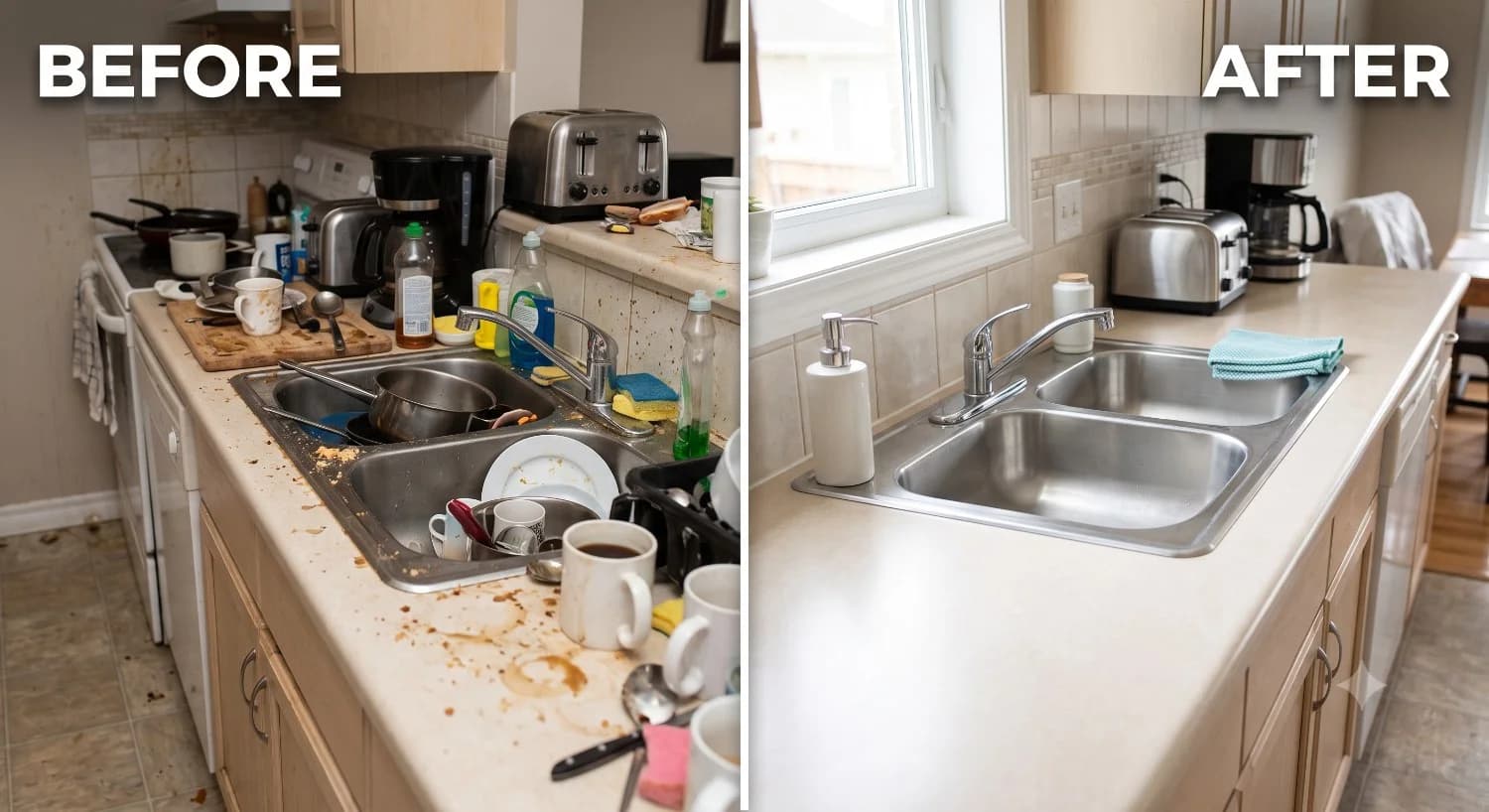
Publish the full room-by-room version, openly, with real before/after photos from an actual job — not stock photography.
Offer the printable checklist as the gated download.
Get a real quote from a technician, something specific, not generic — for example (illustrative, not a real stat): "the number one thing people forget before a deep clean is clearing counters completely — that alone costs us 20-30 minutes a job." Use an actual quote and actual number from your own jobs if you have one; it'll do more work than anything invented.
Pitch a version of it, framed around something seasonal, to a local publication.
Link the guide directly to your deep-cleaning service page.
End the page with: "Would rather skip the checklist and just book it? Get a free deep-cleaning estimate."
That last line matters more than everything above it. It's the difference between content and a lead-generation asset.
The funnel this actually builds
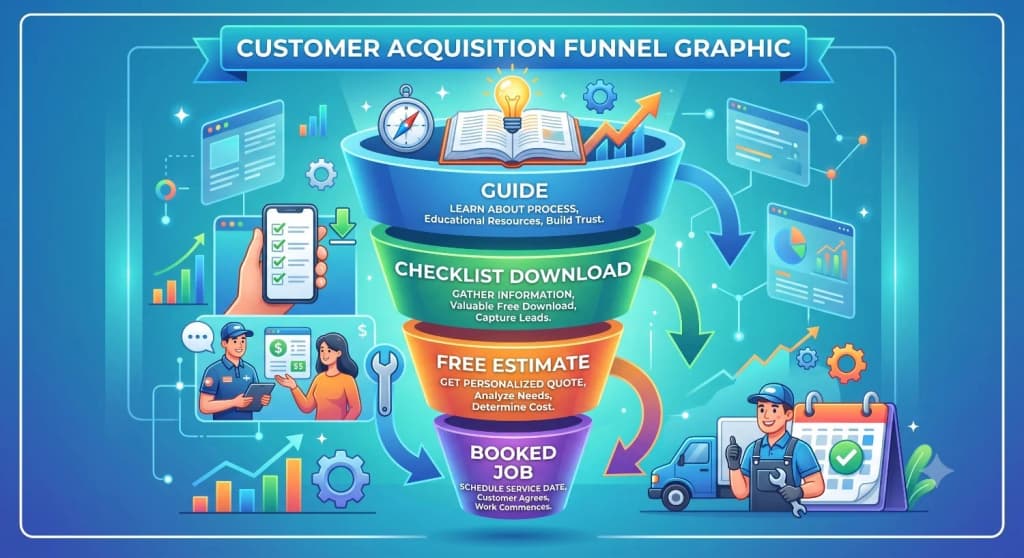
Content → visitor → lead → booking, step by step:
Publish the guide publicly, around a real question.
Put a clear CTA inside it: download the printable checklist.
Capture email or phone right there.
Follow up with something low-friction: a free estimate.
Retarget people who didn't convert the first time.
Use the guide as material for local press or an industry mention — bringing in people who never would've found you otherwise.
Let those mentions build trust for the next person who lands on the page.
Pageviews and rankings are proxies. Calls, quote requests, and booked jobs are the numbers that actually matter — track those.
Why this matters more than it used to
Some homeowners still type "house cleaning near me" into Google and scroll the map results. A growing number ask a chatbot something like "how often should I deep clean my kitchen" or "is it worth hiring a cleaner or just doing it myself" and get an answer synthesized for them, no clicking required.
Clear, useful information and credible corroboration can help a business establish visibility and trust across both traditional search and AI-powered discovery. That's a pattern worth building around, not a guarantee. But it points the same direction either way: be genuinely useful, and don't rely on your own website alone to carry your credibility.
Practically, that means two things. Your content actually has to answer the question, not just gesture at the topic. And your business needs some kind of presence off your own site — reviews, a mention somewhere, a guest post — so you're not the only one vouching for you.
Where this stops helping, and where PR actually fits in
Worth saying plainly, because most content in this space won't: a guide like this, or a press release about it, isn't going to save a business with no reviews and no Google Business Profile. If a homeowner searches "house cleaning near me" and finds three reviews from 2022, nothing you publish is going to fix that first impression. Content and PR earn attention. They don't substitute for the basics.
Once those basics are in place, the next problem is distribution — getting the guide in front of people who aren't already on your site. That can mean local media pickup, an expert quote in an industry roundup, a guest post on a home-services site, or a press release announcing the guide. Each does double duty: it brings in new visitors, and it builds the kind of outside mentions that make everything else you publish more believable.
Most cleaning companies don't have anyone in-house to do that legwork. Already have something worth announcing — a new location, a milestone, a guide like the one above? A platform like TS Newswire can distribute the press release and place guest posts across relevant publisher sites, putting your announcement in front of audiences beyond your own website.
FAQ
What should a cleaning company publish first?
One guide that answers a real, frequently asked question — a cleaning schedule, a cost breakdown, a comparison like maid service vs. cleaning company. One solid piece with a clear path to a quote beats ten generic posts.
Should I gate a cleaning checklist, or keep it public?
Keep the full guide public so it can actually be found. Save the narrower, practical version — a printable checklist or template — as the gated download.
How do I turn blog traffic into actual bookings?
Every piece needs a specific next step — a quote form, a call button, a direct offer tied to what they just read. Content with no next step is a dead end.
Should I make content specific to my city?
Where you can actually say something specific — real local pricing, service-area details, city comparisons — yes. Generic "cleaning tips for [city]" pages with the city swapped in don't help; specific ones do.
How do I get local media or industry attention?
Pitch something genuinely worth covering — a seasonal trend, a real data point from your own jobs, a useful guide — to local publications or industry sites. Or use a distribution service if you don't have a press contact.
How do reviews and outside mentions work together?
Reviews build trust with someone comparing you to the cleaning company down the street. Outside mentions — press, guest posts, roundups — build broader credibility that reinforces everything else, including how you show up in search and AI answers. Neither one replaces the other.
How do I get more cleaning clients? Fix the fundamentals first — a complete Google Business Profile, recent reviews, real service pages. Then publish one genuinely useful guide with a clear next step to request a quote, and back it with a little outside credibility (press, a guest post, a mention). There's no single trick that replaces that order.
What's the best marketing strategy for a cleaning company? There isn't one channel that works alone. Local search fundamentals bring in people actively looking for a cleaning service; useful content brings in people still researching; outside mentions make both of those more credible. Most cleaning companies overinvest in one of the three and skip the other two.
Distribute your next announcement with named outlets
One-time pricing, compliance review for regulated industries, and a publication report with live links you can verify.