

Quick answer
Buyers now ask ChatGPT, Gemini, Claude and Perplexity before they ask Google. For brands, the question has changed from "do we rank?" to "does the AI mention us, and does it get us right?"
Press releases sit in an odd spot in this shift. Some vendors claim a wire release is a shortcut into AI answers. The data says something more useful: distribution helps, but only when it feeds the sources AI actually trusts. This post covers what recent research shows, where wire distribution fits, and how to write releases that earn citations instead of just impressions.
What the 2026 data says about AI visibility
AI engines cite earned, third-party sources almost exclusively, and most brands are not measuring whether they appear at all. Here are the numbers worth knowing.
Finding | Source |
|---|---|
Earned media made up 84% of AI citations across 25M+ links from ChatGPT, Claude and Gemini; paid and advertorial content made up 0.3% | |
Only 16% of brands track AI search performance systematically; laggards could lose up to 50% of traditional search traffic | McKinsey, via Marketing Dive (Aug. 3, 2026) |
Over 40% of brands cited in organic results don't appear in AI Overviews for the same query | LQ Digital, via Marketing Dive (July 1, 2026) |
60% of URLs cited by major AI engines didn't rank in Google's or Bing's top 20 for the same prompt | Cited in Marketing Dive (Aug. 6, 2026) |
Only 11% citation overlap between AI engines: you can lead in ChatGPT and be absent in Perplexity | Profound, via Marketing Dive (Aug. 6, 2026) |
63% of LLM visibility comes from long-term brand building; marketing spend drives 22% |
Two takeaways. Ranking on Google no longer guarantees you show up in AI answers. And you cannot buy your way into those answers with ads.

The uncomfortable truth: a wire release is not earned media
A press release you pay to distribute is owned content on a third-party domain. It is not a journalist choosing to cover you. Any distributor that sells a release pickup on Yahoo Finance or AP News as "earned coverage" is overselling.
That matters because the citation data rewards independent validation. A syndicated release page labeled "press release" will rarely carry the weight of a reporter's article about the same news.
So is distribution pointless for AI search? No. It just does a different job than most people assume.
What press release distribution actually does for AI visibility
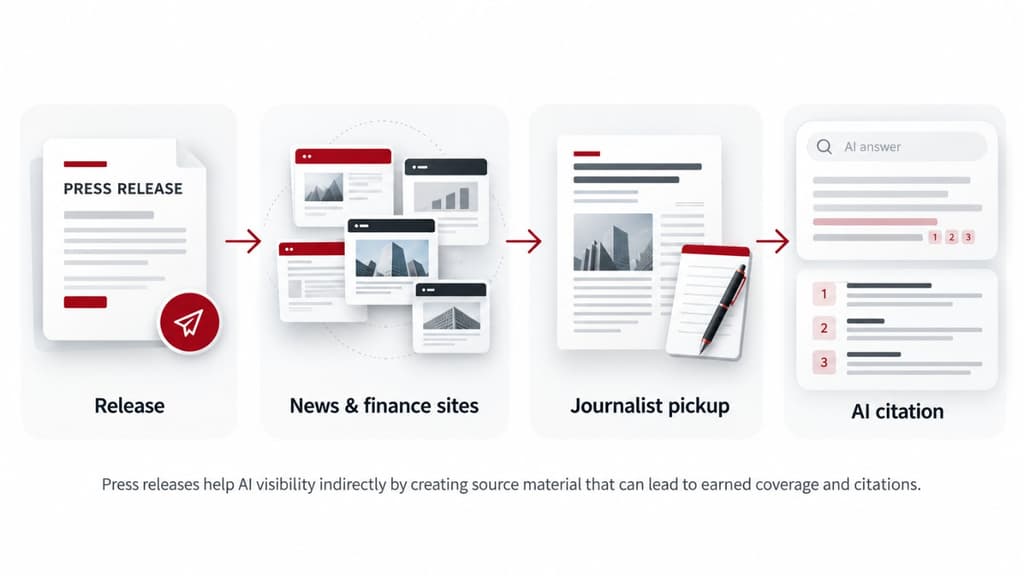
Distribution works as the source layer that earned media and AI engines build on. It does four jobs well.
It puts your facts on record. A release on trusted news and finance sites, such as Yahoo Finance or the USA Today network, gives AI crawlers a dated, attributable version of your announcement, numbers and executive names.
It feeds journalists. Reporters still scan wires for story leads. One pickup by a real outlet is worth more for AI citations than fifty syndicated copies.
It keeps your narrative consistent. Marketing Dive's August guest column notes that AI engines skip brands whose story conflicts across sources. Repeated, consistent boilerplate across many domains helps models describe you the same way every time.
It builds entity signals. Your brand name tied to the same category terms, again and again, is how a model learns what you are. This is what turns into the "long-term brand building" behind most LLM visibility.
What it won't do: replace coverage, fix a weak story, or make one release show up in every AI answer next week.
How to write a press release AI engines will actually use
Write every release as a fact sheet a model can lift cleanly. Use this checklist before you hit submit.
Answer first. Put who, what and the key number in the first 40 words.
Raise fact density. Swap adjectives ("leading", "innovative") for figures, dates, prices and named customers.
Name the entity precisely. Use the full company name, category and location, worded the same way in every release.
Write a real boilerplate. State what you do, for whom, since when and where, with no slogans. We place 200+ releases a month on the USA Today network, and weak boilerplate is one of the top reasons a release gets bounced by editorial review. Our press release writing guide walks through the fix.
Quote with substance. An executive quote should add a claim or context, not "we're thrilled".
Link to proof. Point to the product page, data source or filing that backs each claim.
Add a short FAQ. Two or three direct Q&As map neatly onto the questions people ask AI tools.
Keep your own site crawlable. Check that robots.txt doesn't block AI crawlers from your newsroom page.
Tell a story worth covering. Data, a first, or a clear customer outcome gives a journalist a reason to write about you.
How to measure whether it's working
Stop reporting pickups alone and start tracking how AI engines describe you. In August 2026 the IAB published a framework built on four Ps, as reported by Marketing Dive:
Presence: how often you're mentioned or cited.
Prominence: where you appear in the answer and in what order.
Portrayal: sentiment, framing and factual errors.
Persuasion: how strongly you're recommended and whether people click through.
A simple starting routine: pick 10 to 20 buyer questions in your category. Each month, run them in ChatGPT, Gemini, Perplexity and Claude, and log whether you appear, where, and what's said. Test each engine separately, since their citation sources barely overlap. Then compare results before and after each announcement.
FAQ
Do press releases help with AI search? Yes, indirectly. They put verifiable facts on trusted domains and can trigger the earned coverage that AI engines cite most.
Is a syndicated press release the same as earned media? No. It is distributed owned content. Earned media is when an independent journalist or publication chooses to cover you.
How long until a release affects AI answers? There's no fixed timeline. Models and AI search tools refresh sources at different speeds, so track monthly rather than expecting results within days.
Which distribution network is best for AI visibility? The one that gets your release onto credible, crawlable news and finance sites relevant to your industry, in front of reporters who cover it. Network size matters less than relevance. Ask any provider to name its outlets before you pay; ours are listed in our network directory.
The bottom line
AI search doesn't make press releases obsolete; it raises the bar for them. Releases that are fact-dense, consistent and newsworthy become the record AI engines learn from and the leads journalists act on. Generic announcements blasted to hundreds of sites do neither.
TS Newswire distributes releases to 1,240+ named outlets, with compliance review for regulated industries like iGaming and crypto. Every order ships with a report of live links. In one recent campaign, a telecom company's filing announcement reached 527 full-text placements and picked up 23 AI citations in a single reporting window (see a sample report). If you want your next announcement built for journalists and AI engines alike, compare plans and pricing.
Distribute your next announcement with named outlets
One-time pricing, compliance review for regulated industries, and a publication report with live links you can verify.