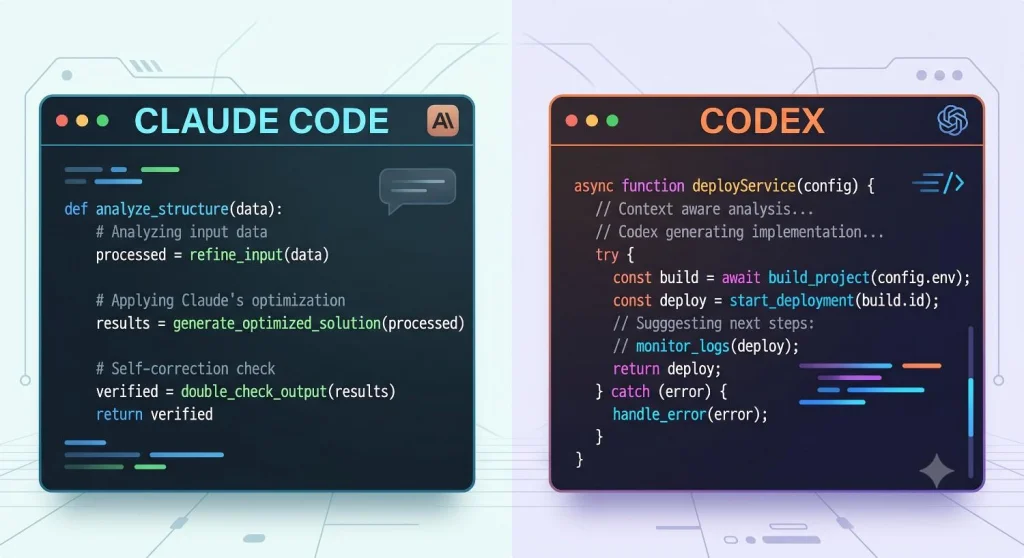
AI, in the form that matters to builders right now, is software that generates text, code, or decisions by predicting patterns from huge amounts of training data — not software that understands your product. In coding specifically, tools like Claude Code and OpenAI's Codex have gotten good enough to write real, working features inside real projects. We've used both to build a marketplace and an internal AI tool, Marcus OS. They're genuinely useful. They are not yet a replacement for someone who understands how a database should actually be structured. That gap — not model quality — is the real story of AI coding in 2026.
What AI actually is, in one paragraph
Skip the philosophy. The AI you interact with in coding tools is a large language model: a system trained on huge volumes of text and code that predicts the most statistically likely next step given your instructions and the context it can see. It doesn't "know" your business. It doesn't know why you chose a one-to-many relationship over a many-to-many one three months ago. It knows patterns. Give it enough of the right context, and it produces genuinely strong output. Give it a vague prompt, and it fills the gaps with whatever pattern is most common in its training data — which is often not what your specific product needs.
The current AI coding landscape: Claude Code vs. Codex vs. the rest
Two tools currently dominate the "agentic coding" conversation — meaning tools that don't just autocomplete a line, but can plan, write, run, and fix multi-file changes on their own.
Claude Code (Anthropic) is terminal-native and built around keeping a developer in the loop. Independent testing shows it consistently produces cleaner, more idiomatic code in blind review, and it holds a real edge on long-context reasoning and complex, whole-repository tasks. It's also grown well past a simple chat-in-terminal tool: Plan Mode lets it explore a codebase and propose a structured implementation plan before writing anything, subagents can be spun up to handle isolated side tasks (log analysis, dependency audits) without cluttering the main session, and a hooks-and-skills system lets teams enforce deterministic rules and package reusable procedures. That flexibility is a strength, but it also means someone still has to set it up with the right architecture in mind — the tool doesn't invent good structure on its own.
Codex (OpenAI) is built for velocity — it's an open-source, terminal-based coding agent OpenAI maintains directly (alongside a cloud version, Codex Web, and IDE integrations), leaning toward autonomy over developer supervision. It's typically faster and meaningfully cheaper per completed task — most current benchmarking puts it at roughly 3–4x more token-efficient than Claude Code for comparable work.
Neither tool exists in a vacuum — GitHub Copilot, Cursor, Windsurf, and Gemini CLI all compete in the same space, mostly differentiated by how deeply they integrate into an existing editor versus running as an independent terminal agent. But Claude Code and Codex are currently the two names dominating the "agentic coding" conversation specifically.
The data backs up what a lot of developers already feel day to day. In a 500+ developer survey, roughly two-thirds of respondents said they preferred using Codex for daily work, yet blind code reviews rated Claude Code's actual output as cleaner about two-thirds of the time — a split between what feels smoother to use and what's actually better once you read the diff. On raw benchmark capability, the two are close but split by test type: on SWE-bench Verified, Claude Opus 4.7 scored 87.6% against GPT-5.5's 88.7%, while on the harder SWE-bench Pro, Claude held the lead at 64.3% to GPT-5.5's 58.6% — up from the low-50s just one version earlier. Meanwhile, hands-on comparisons after 100+ hours of production use found Codex edging ahead on overall practical scoring even as testers rated the underlying Claude model's tool-calling and instruction-following as stronger. No tool wins cleanly on every axis, which is exactly why serious teams are increasingly running both — one agent generating, the other reviewing — rather than picking a single winner.
Our own read, after building a live marketplace and an internal tool (Marcus OS) with both: Claude Code is the stronger of the two for us, but not because it's flawless. UI generation is the weak point — we'd rate it roughly 5/10 there. Actual application logic and code quality is where it earns its reputation — closer to 8/10 once you've given it real context to work with.
None of this is an argument that these tools are overhyped. In our own use, they're excellent at:
Boilerplate generation — auth scaffolding, CRUD endpoints, config files, repetitive component structures
Refactoring — renaming, restructuring, and cleaning up code that already works
Test creation — unit and integration test scaffolding once the logic is settled
Documentation — turning working code into readable docs and comments
Repetitive, well-defined tasks — the kind of work that used to eat a junior developer's whole day
Where they consistently need a human is the opposite end of that list: original architecture, database and schema decisions, and anything that depends on context the model can't see — your team's constraints, your compliance requirements, your actual growth plan.
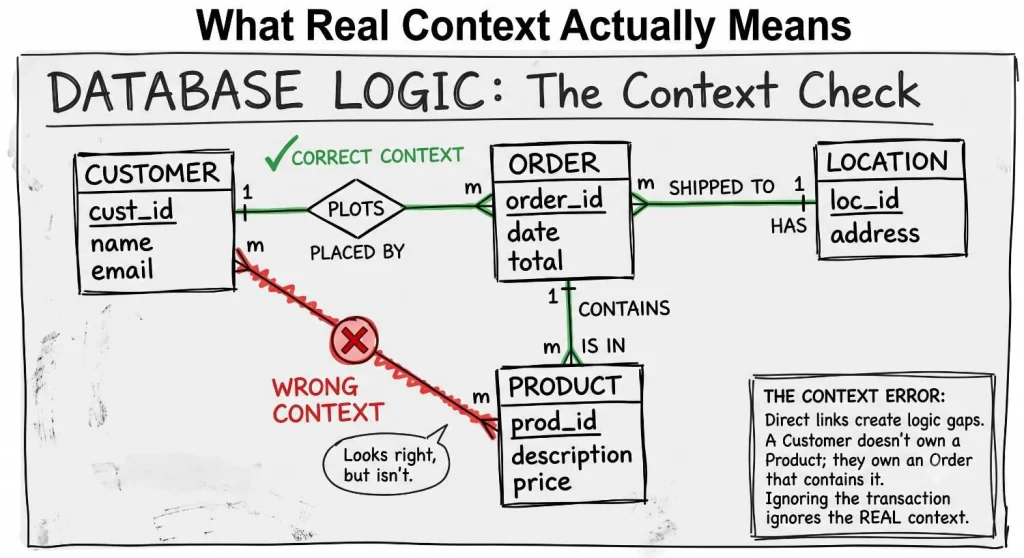
What "real context" actually means — and where AI coding tools fail without it
Here's the part comparison articles usually skip: neither Claude Code nor Codex reliably gets your product's internal logic right on the first pass. When we were building Marcus OS, we needed a specific data and process logic — not the generic pattern either tool defaults to. Both tools initially built something that looked reasonable on the surface but wasn't what the product actually needed. It took explicitly explaining the reasoning behind the logic — not just what to build, but why it had to work that way — before the output matched what we actually needed.
This isn't a Claude-versus-Codex problem. It's a structural one. As one detailed 2026 analysis on AI and software careers put it, designing a database schema for a domain the model hasn't seen requires understanding constraints that live outside the codebase entirely — team size, deployment infrastructure, compliance requirements, growth projections. An AI model can't infer those from a prompt. Only someone who understands the product can supply them — and only someone with real database and architecture knowledge can tell, at a glance, when the AI's output is subtly wrong rather than just different.
A well-known voice in the database community made a related point bluntly: the context behind why a schema was designed a certain way tends to get lost over time, because most teams still don't document their databases properly — AI tooling doesn't fix that problem, it just generates the next layer on top of whatever's already undocumented. That's exactly the failure mode we hit: without someone who could say "no, that's not how this relationship actually works," the AI-generated structure would have shipped wrong.
A simple version of this problem, even outside our own project: ask an AI coding tool to model "users belong to organizations," and it will very often default to a one-to-many relationship — one organization, many users — because that's the statistically common pattern. If your actual product needs users to belong to multiple organizations (a many-to-many membership model), the AI-generated code will compile, the app will run, and it will be wrong in a way that doesn't show up until real usage exposes it. Nothing about that failure looks broken until it's already in production.
Why every AI-coding builder still needs to understand code and database design
This is the uncomfortable part most "AI will replace developers" takes skip. AI coding tools are good — arguably 8/10 good on logic, in our experience — but only when someone who understands software can direct them, catch the parts that look right but aren't, and correct course. Hand these tools to someone with zero coding or database background and the failure mode isn't "it doesn't work" — it's worse: it often looks like it works, right up until it doesn't, in production, with real users.
The hiring data reflects this shift already. Entry-level roles that used to ask for one to two years of experience now commonly ask for two to five, and a large share of hiring managers now say AI can handle intern-level work on its own. That's not evidence junior developers are obsolete — it's evidence the bar for "useful with AI tools" has quietly moved up to include architectural judgment that used to come later in a career.
A simple way to place where your team actually is
Level | What it looks like |
|---|
1. AI autocomplete | Inline suggestions while you type — Copilot-style |
2. AI pair programmer | You drive, AI assists one file/task at a time |
3. AI coding agent | AI plans and executes multi-file changes — Claude Code, Codex |
4. AI reviewer | AI checks another AI's (or a human's) output for correctness |
5. AI engineering team | Multiple agents collaborate with minimal human intervention |
Most teams using Claude Code or Codex today are somewhere between levels 3 and 4 — genuinely useful autonomy, with a human still required to define the architecture the agent works within. Level 5 is the version people picture when they say "AI will replace developers." Nothing in the current data suggests that's close.
The five mistakes we see most often when founders lean too hard on AI coding tools:
Giving the tool a task without giving it the why behind the logic
Skipping schema design and letting the AI infer relationships from scratch
Accepting generated code without a human reviewing the architecture
Not documenting the reasoning behind structural decisions, so the next AI session (or the next hire) has to rediscover it
Expecting the model to infer business rules it was never told
So is AI coding "the future" or not?
Yes — just not the version most people are picturing. Right now, in mid-to-late 2026, the realistic picture is: AI coding tools are extremely strong accelerants for developers who already know what good architecture looks like, and they're a genuine risk for anyone who doesn't. That's not a knock on the tools — Claude Code and Codex are both dramatically better than they were even a year ago, and the trajectory is clearly upward. But "upward" and "ready to replace a team that actually understands your database" are two different claims. Right now, the human team — the one that understands structure, not just syntax — is still the thing making the AI's output usable.

FAQ
Is Claude Code better than Codex? Depends what you're optimizing for. Claude Code tends to produce cleaner code and handles complex, long-context tasks better. Codex is faster, cheaper per task, and better suited to autonomous, less-supervised workflows. Many experienced teams now use both together rather than choosing one.
Can I build a real product using only AI coding tools? You can get a working prototype fast. Whether it holds up depends almost entirely on whether someone involved understands database structure, system architecture, and can catch logic that looks correct but isn't.
Do I need to know how to code to use AI coding tools well? You don't need to type every line yourself, but you do need enough understanding to evaluate whether the AI's output is actually correct for your product — especially around data structure and relationships, which is where these tools are weakest without detailed guidance.
Will AI coding tools eventually replace developers entirely? Not on current evidence. The tools are closing gaps in speed and syntax fast. The gap in judgment — knowing why a structure should work a certain way for a specific business — hasn't closed at the same rate.
Built something with AI coding tools and ready for people to actually see it? That's a different problem than the one AI solves. TS Newswire places founder and product stories in outlets including Yahoo Finance, USA Today, Reuters, AP News, Entrepreneur, CPO Magazine, Dallas Observer, and Outlook India — real press release distribution and guest post placement, not AI-generated filler. If you've built the product, we can help make sure the right people actually hear about it.

 Vivek Sharma
10 min read
85 views
Vivek Sharma
10 min read
85 views